
What Is GenAIEmbed and How Does It Increase E-commerce Conversion and Average Order Value?

Product Marketing strategist


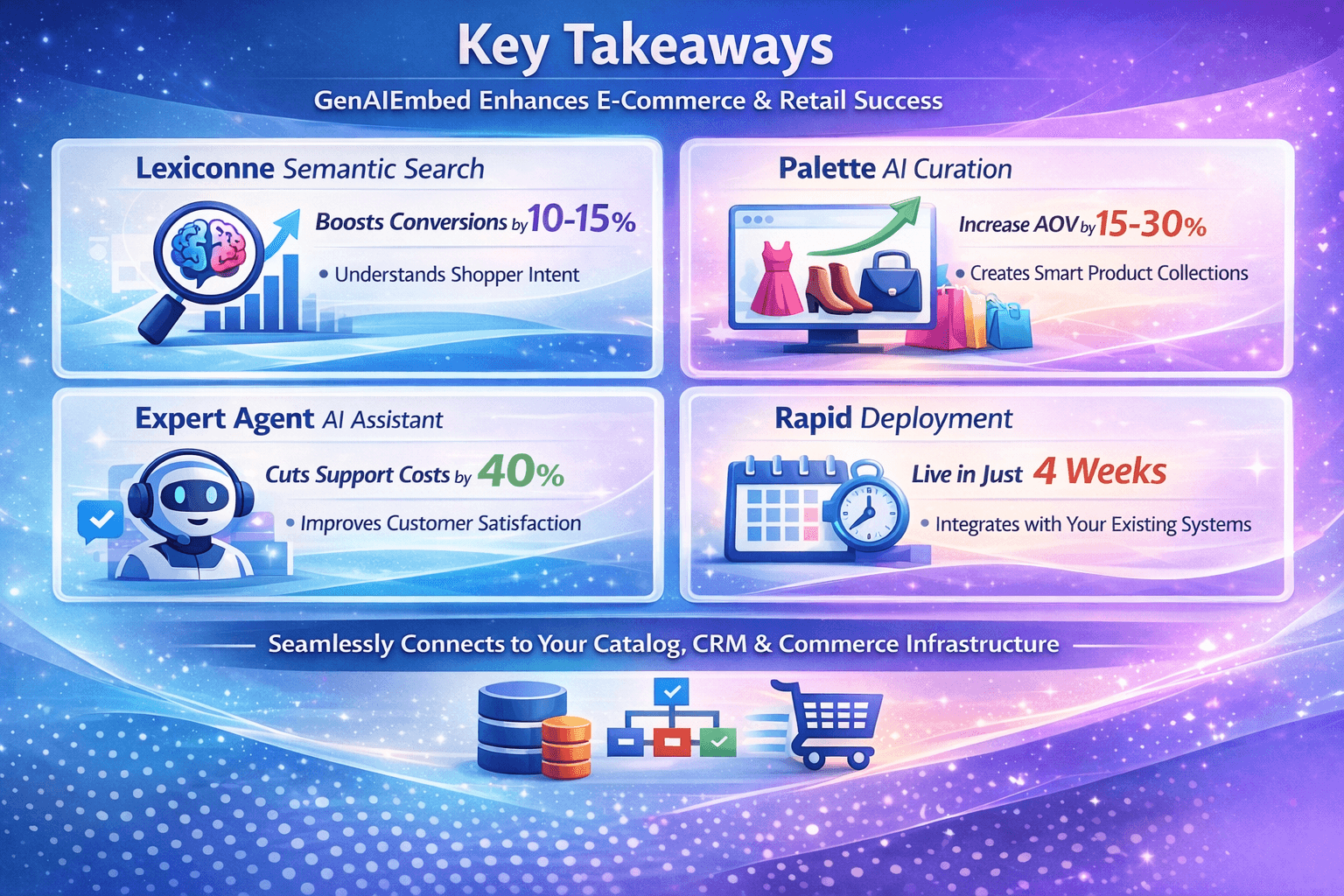
Key Takeaways
GenAIEmbed is an AI platform that improves product discovery, merchandising, and customer support for e-commerce and retail businesses, without replacing existing tech stacks.
Its semantic search engine, Lexiconne, increases conversion rates by 10-15% by understanding shopper intent, not just keywords.
Its AI curation engine, Palette, increases average order value by 15-30% by generating contextual product collections automatically.
Its AI retail assistant, Expert Agent, reduces customer support costs by up to 40% while improving satisfaction scores.
Deployment takes approximately four weeks and connects to existing catalog, CRM, and commerce infrastructure.
What Is GenAIEmbed?
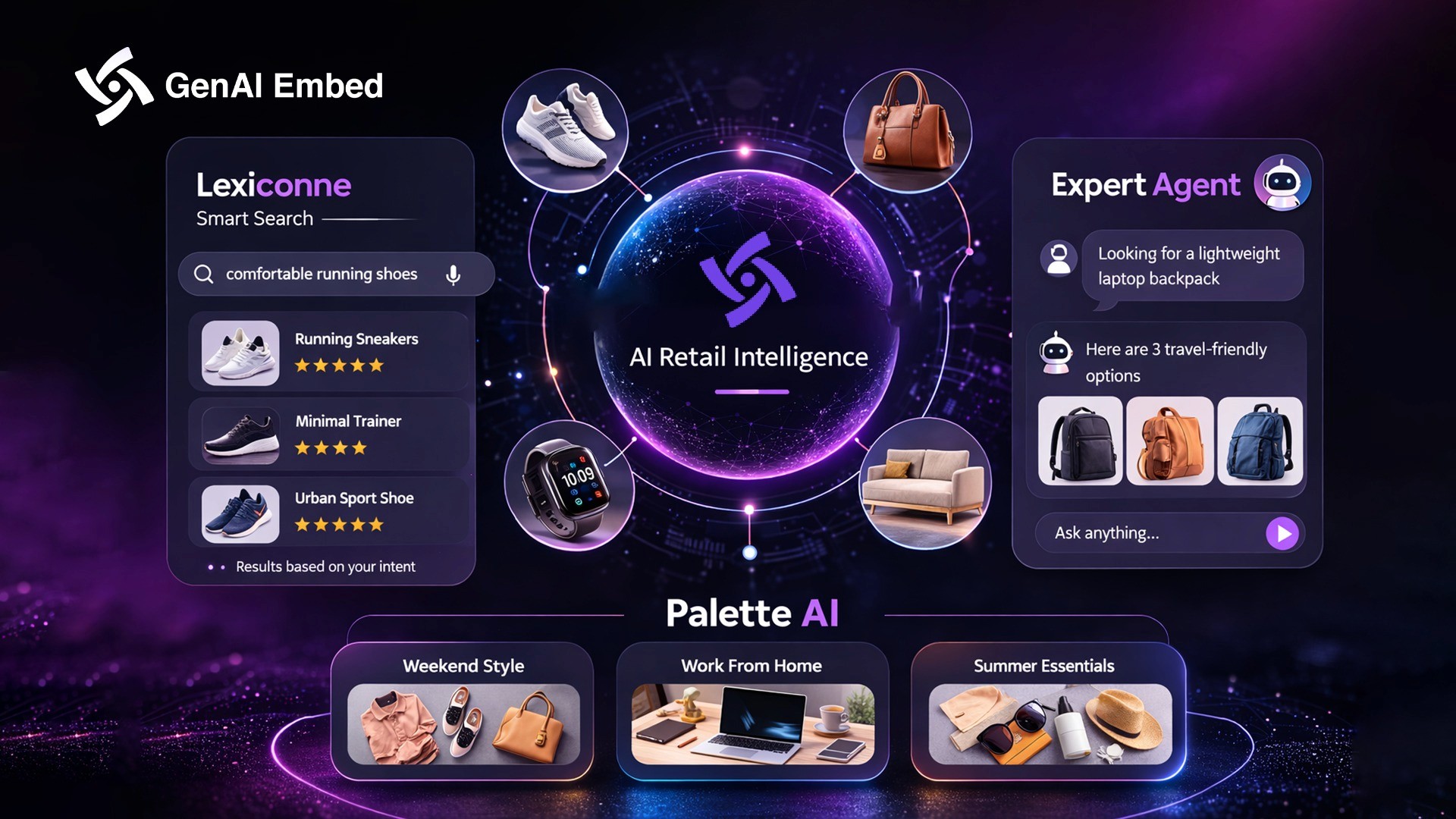
GenAIEmbed is an AI-powered retail intelligence platform designed for e-commerce businesses in the United States. It improves three core areas of the online shopping experience: product search, product discovery, and customer support, all through a single integrated API layer that connects to existing commerce infrastructure.
GenAIEmbed is built on three distinct product engines:
GenAIEmbed Product Suite
Product | Function | Primary Outcome | Best For |
|---|---|---|---|
Lexiconne | Semantic Search Engine | +10-15% Conversion Rate | Product discovery and search quality |
Palette | AI Collection Curation | +15-30% Average Order Value | Merchandising and upsell automation |
Expert Agent | AI Retail Assistant | -40% Support Costs | Customer service and product guidance |
The Hidden Revenue Problem Costing E-commerce Leaders Millions
The single largest source of lost revenue in e-commerce is not traffic. It is failed product discovery.
Industry research shows that site search users convert two to three times more often than average visitors. Yet most U.S. online retailers still rely on keyword-based search systems that cannot understand natural language queries.
When a shopper searches for "comfortable work-from-home clothes" or "minimalist sofa for small apartments," a keyword engine matches on individual words, not intent. The result: irrelevant product listings, high exit rates, and abandoned carts.
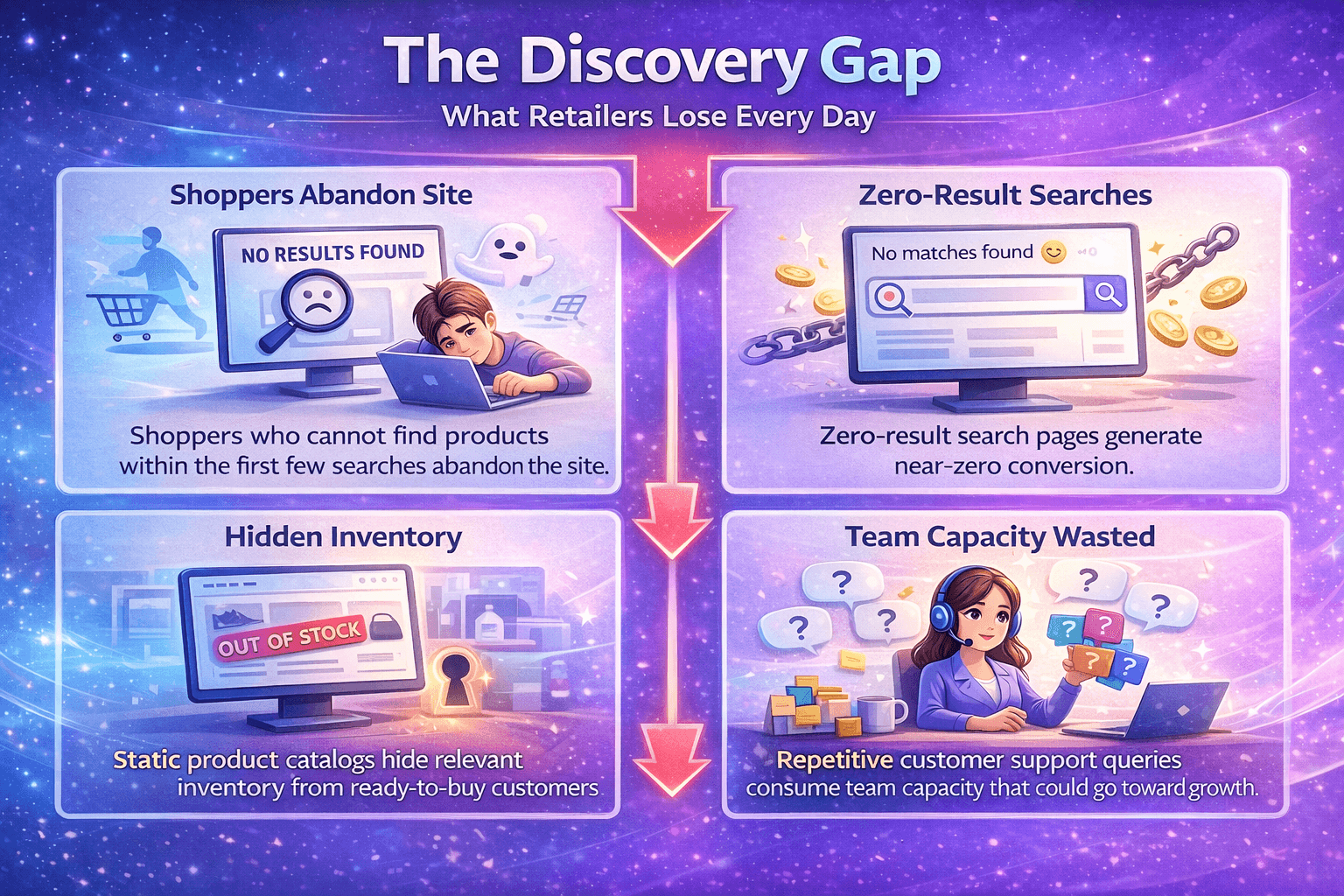
The Discovery Gap - What Retailers Lose Every Day
Shoppers who cannot find products within the first few searches abandon the site.
Zero-result search pages generate near-zero conversion.
Static product catalogs hide relevant inventory from ready-to-buy customers.
Repetitive customer support queries consume team capacity that could go toward growth.
Why Traditional E-commerce Optimization No Longer Works
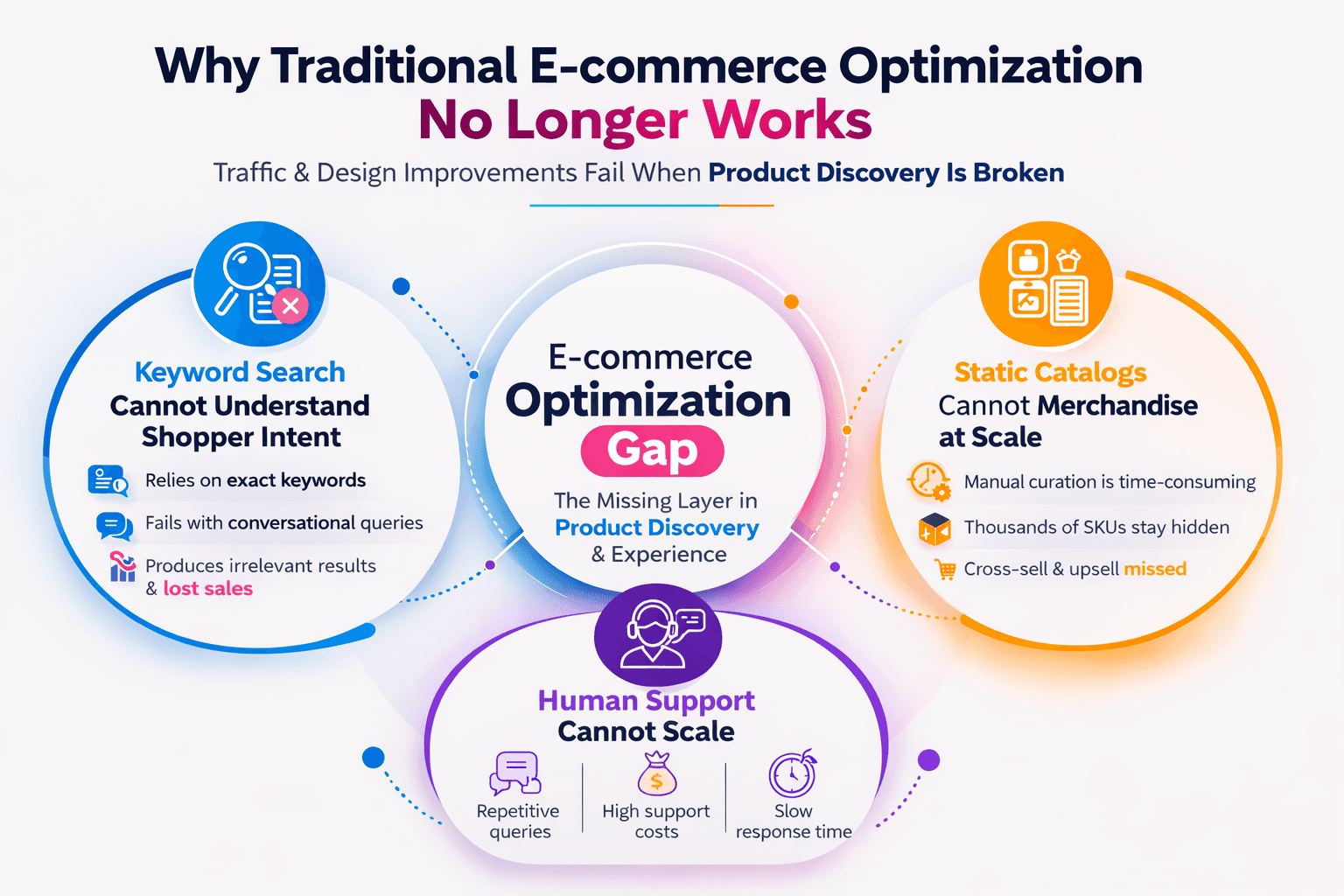
Most e-commerce teams optimize for the wrong layer of the funnel. Traffic, ad spend, and page design improvements generate diminishing returns when the underlying product discovery experience is broken.
Problem 1: Keyword Search Cannot Understand Shopper Intent
Traditional search tools prioritize exact keyword matches. Modern shoppers search using descriptive, conversational phrases. This mismatch produces irrelevant results, frustrated users, and lost sales, regardless of how much catalog inventory is available.
Problem 2: Static Catalogs Cannot Merchandise at Scale
Retailers managing thousands of SKUs cannot manually curate meaningful product groupings for every shopper segment, season, or trend. Without AI-assisted merchandising, relevant cross-sell and upsell opportunities go unrealized.
Problem 3: Human Support Cannot Scale with Customer Volume
A large portion of retail customer service interactions involve repetitive, answerable questions: order status, sizing guidance, and product care. Staffing human agents to handle this volume at scale is expensive and limits bandwidth for higher-value customer interactions.
How GenAIEmbed Works: Three AI Engines, One Platform
01 - Lexiconne: AI Semantic Search Engine
What it does: Lexiconne replaces keyword-based product search with semantic search technology that understands the intent, context, and meaning behind each shopper query, including natural language phrases, descriptive searches, and negative constraints (e.g., "not white").
Understands natural language queries and contextual meaning
Eliminates near-zero-result search pages
Surfaces relevant products even when product titles do not match search terms exactly
Measured outcome: 11% higher conversion rate | 80% reduction in search exit rate
02 - Palette: AI Collection Curation Engine
What it does: Palette transforms static product bundles into AI-generated thematic collections organized around customer situations and experiences, not just product attributes. Instead of listing individual items, it presents curated groupings such as "Minimalist Home Office Setup" or "Weekend Travel Essentials."
Auto-generates contextual product collections from existing catalog data
Increases basket size by encouraging multi-item exploration
Adapts collections dynamically based on trends, season, and inventory
Measured outcome: 15-30% increase in average order value from pilot deployments
03 - Expert Agent: AI Retail Assistant
What it does: Expert Agent is a domain-trained AI assistant that handles repetitive customer inquiries including order tracking, product recommendations, sizing guidance, compatibility questions, and care instructions. It draws answers from verified product documentation and internal systems, not hallucinated responses.
Responds 24/7 to common retail support queries without human agents
Cites sources and verified documentation rather than generating unverifiable answers
Trained on retail-specific domains: apparel, furniture, beauty, and home goods
Measured outcome: Up to 40% reduction in support costs | 20-35% improvement in customer satisfaction scores
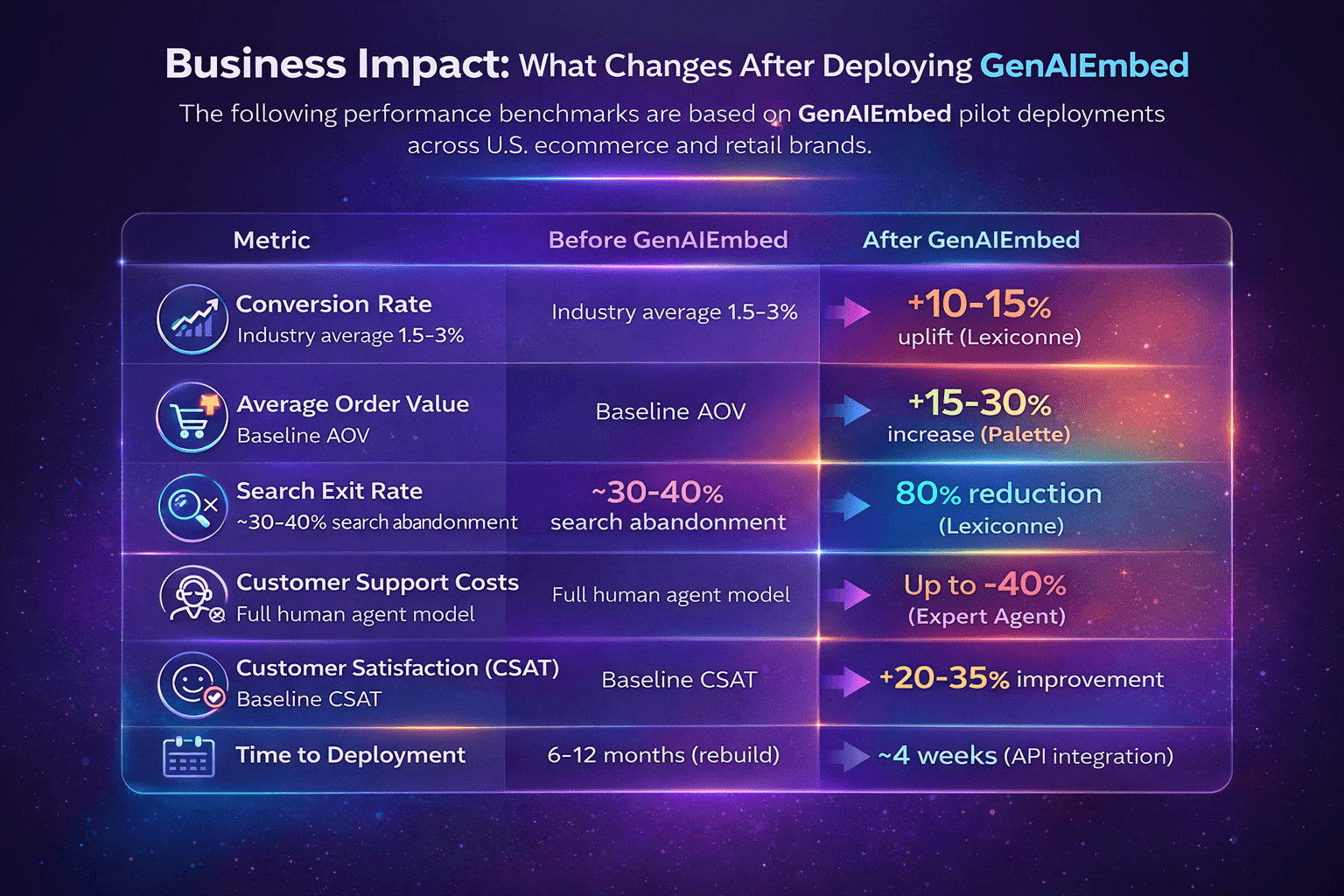
Business Impact: What Changes After Deploying GenAIEmbed
The following performance benchmarks are based on GenAIEmbed pilot deployments across U.S. e-commerce and retail brands.
Metric | Before GenAIEmbed | After GenAIEmbed |
|---|---|---|
Conversion Rate | Industry average 1.5-3% | +10-15% uplift (Lexiconne) |
Average Order Value | Baseline AOV | +15-30% increase (Palette) |
Search Exit Rate | ~30-40% search abandonment | 80% reduction (Lexiconne) |
Customer Support Costs | Full human agent model | Up to -40% (Expert Agent) |
Customer Satisfaction (CSAT) | Baseline CSAT | +20-35% improvement |
Time to Deployment | 6-12 months (rebuild) | ~4 weeks (API integration) |
Why Retail Leaders Are Deploying AI Search and Discovery Now
Three structural shifts in the U.S. retail market are making AI-powered product discovery a near-term competitive necessity, not a future consideration.
Consumer Expectations Have Moved to AI-Native Interfaces
Shoppers increasingly interact with AI assistants, voice search, and conversational commerce tools. They now expect online stores to understand natural language queries, not just keyword inputs. Retailers that deliver keyword-only search experiences are falling behind consumer expectations shaped by platforms like Amazon, Google, and ChatGPT.
SKU Proliferation Has Made Manual Merchandising Unscalable
Mid-to-large retailers in the U.S. routinely manage 50,000 to 500,000 SKUs. Manual curation of product collections, cross-sell logic, and search rankings at this scale is economically unfeasible. AI-assisted merchandising is no longer a competitive advantage. It is the only viable operating model at scale.
Experience Is Now the Primary Retail Differentiator
Price competition in U.S. e-commerce has intensified to near-commodity levels across most product categories. The retailers building durable competitive advantages in 2025 and beyond are those delivering faster, smarter, and more personalized shopping experiences, not those offering the lowest prices.
Common Questions from Retail Executives
"We already have a search platform. Why switch?" Most existing retail search tools operate on keyword matching or Elasticsearch-based ranking. Semantic search is a different technology layer: it interprets meaning and context rather than matching character strings. Lexiconne does not replace your search UI. It upgrades the intelligence behind it. The outcome is measurably higher relevance for natural language queries, which account for an increasing share of shopper behavior.
"We don't have an internal AI team." GenAIEmbed is delivered as an API-first platform, not an in-house machine learning project. Integration connects to existing product catalog systems, CRM tools, and commerce platforms. No internal AI expertise is required for deployment or ongoing management. The implementation process is guided and typically completes in approximately four weeks.
"Integration sounds complex and risky." GenAIEmbed follows a structured onboarding process, covering catalog data ingestion, API connection, and configuration, with implementation support included. Retailers enhance their existing commerce stack rather than replace it. The platform is designed to connect to Shopify, Salesforce Commerce Cloud, Magento, and custom commerce infrastructure.
"How long before we see measurable results?" Most retailers deploying GenAIEmbed see initial performance improvements within the first 30 days of production deployment. Search quality improvements from Lexiconne are typically measurable within the first two weeks. Collection performance from Palette and support deflection from Expert Agent follow within the first full billing cycle.
Frequently Asked Questions (FAQ)
What is GenAIEmbed? GenAIEmbed is an AI-powered retail intelligence platform that provides semantic search, AI collection curation, and AI customer assistance for e-commerce businesses. It integrates with existing commerce infrastructure via API and is designed for retailers managing large product catalogs in the U.S. market.
How does GenAIEmbed increase e-commerce conversion rates? GenAIEmbed increases conversion rates through its Lexiconne semantic search engine, which understands natural language shopper queries rather than relying on keyword matching. By returning more relevant product results, shoppers find what they are looking for faster, reducing exit rates and increasing purchase likelihood. Pilot deployments have shown an 11% average uplift in conversion rate.
What is the difference between semantic search and keyword search for retail? Keyword search matches query text to product titles and descriptions using character-level string matching. Semantic search analyzes the intent and meaning behind a query, understanding that "comfortable WFH clothes" means something different than "office clothes," even if the words partially overlap. For retailers, semantic search returns dramatically more relevant results for the natural language queries that modern shoppers use.
How does GenAIEmbed increase average order value? The Palette engine in GenAIEmbed automatically generates thematic product collections from existing catalog data, grouping items around customer situations rather than product attributes. When shoppers browse curated collections such as "Minimalist Living Room Setup" instead of isolated product pages, they explore more items and purchase more products per transaction. Pilot programs report AOV improvements of 15-30%.
How long does it take to deploy GenAIEmbed? The standard GenAIEmbed deployment timeline is approximately four weeks from initial data integration to production. This includes catalog ingestion, API connection to the existing commerce platform, and configuration of all three engines: Lexiconne, Palette, and Expert Agent.
Does GenAIEmbed require replacing existing commerce technology? No. GenAIEmbed is an API-first platform that adds an AI intelligence layer to existing e-commerce infrastructure. It connects to current catalog systems, CRM platforms, and commerce engines rather than replacing them. Retailers keep their existing storefront, product management systems, and order management tools.
What retail sectors is GenAIEmbed designed for? GenAIEmbed's Expert Agent is trained on retail-specific domains including apparel, furniture, beauty, and home goods. The platform is designed for mid-to-large U.S. e-commerce and retail businesses, particularly those managing large SKU catalogs where manual merchandising and keyword search have become performance bottlenecks.
How does GenAIEmbed reduce customer support costs? The Expert Agent component automates responses to high-volume, repetitive customer inquiries including order tracking, product recommendations, sizing guidance, and product care instructions. It draws answers from verified product documentation and internal systems rather than generating unverified responses. Deployments have achieved up to 40% reduction in customer support operational costs.
The Next Step for Retail Leaders
The largest untapped growth opportunity for most U.S. e-commerce businesses is not more ad spend or a platform migration. It is making the existing catalog and customer experience significantly smarter.
Retailers deploying GenAIEmbed report measurable improvements in conversion rate, average order value, and customer satisfaction within the first 30-60 days, without disrupting their current commerce stack.
Ready to see what AI-powered discovery looks like for your catalog? Schedule a GenAIEmbed demo and receive a no-cost product discovery audit for your store.
Book Your Demo at genaiembed