
AI Shopping Assistant for Ecommerce and Retail Teams

Product Marketing strategist
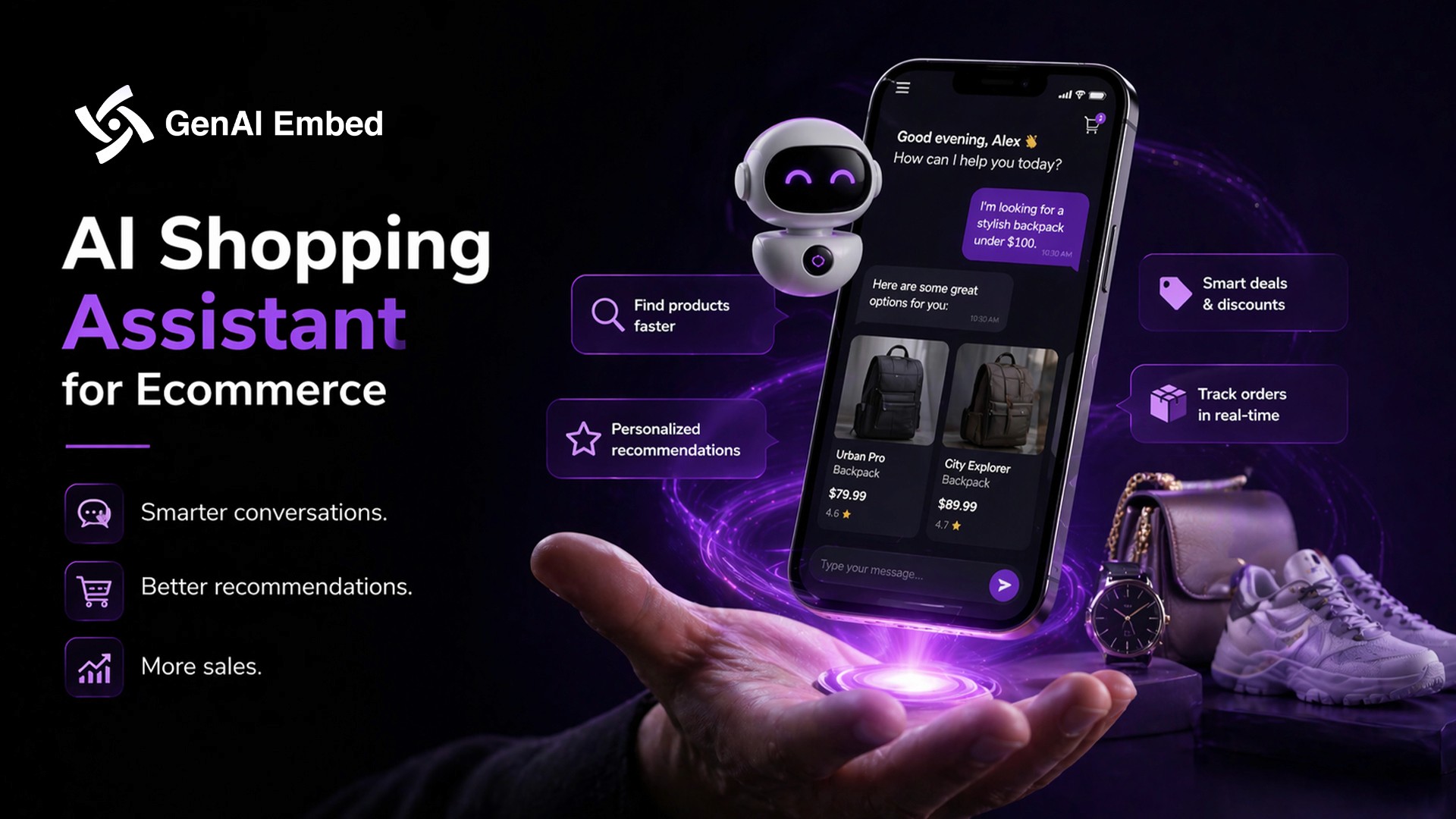


97 out of every 100 visitors to your ecommerce store leave without buying anything.
That is not a traffic problem. Traffic is showing up. The problem is what happens after they arrive. Shoppers land on a product grid with no guidance, no context, and no one to answer the one question standing between them and a purchase. So they leave.
An AI shopping assistant solves this problem at the exact moment it matters most. It engages shoppers in real-time conversation, understands what they are actually looking for, and guides them from uncertainty to a confident purchase decision.
The results are not modest. Shoppers who engage with an AI shopping assistant convert at 12.3% compared to 3.1% for those who shop without assistance, a four-times conversion lift, according to Rep AI data cited by Anchor Group. They complete purchases 47% faster. Returning customers who use AI assistance spend 25% more per session.
This guide covers what an AI shopping assistant actually is in 2026, why the category has moved far beyond basic chatbots, which capabilities deliver the strongest measurable results, and how to evaluate whether your store is ready to deploy one effectively.
What Is an AI Shopping Assistant for Ecommerce?
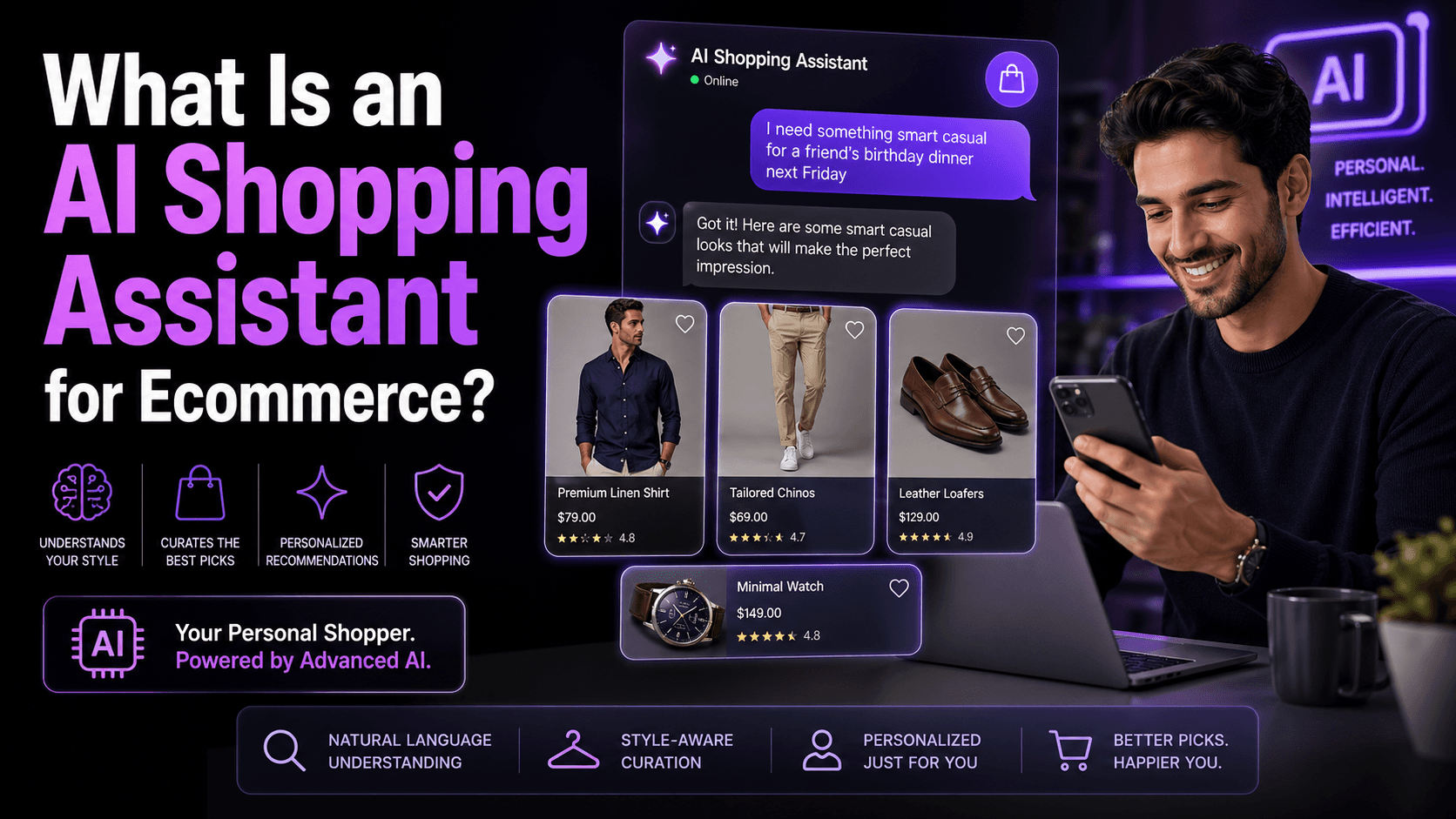
An AI shopping assistant is a conversational AI system embedded in an ecommerce store that actively guides shoppers through product discovery, helps them evaluate options, answers questions in real time, and assists them in making confident purchase decisions.
It is not a FAQ bot. It is not a customer service widget that handles returns and shipping queries. It is a proactive, intelligent system that functions like a knowledgeable sales associate available to every visitor simultaneously, at any hour, without ever needing a break.
The distinction matters because most ecommerce brands have deployed some form of chatbot and concluded that the ROI was marginal. Traditional chatbots operate on scripted decision trees. They can answer pre-defined questions, but they fall apart the moment a shopper asks something outside the script.
A genuine AI shopping assistant uses large language models to understand natural language, interprets shopper intent in context, and generates responses that feel like actual guidance rather than keyword-triggered outputs. When a shopper says "I need something smart casual for a friend's birthday dinner next Friday," the assistant understands the occasion, the aesthetic requirement, the urgency, and the gifting context, all in a single prompt, and responds with relevant, specific product suggestions.
One-quarter of all shoppers will use specialty AI retail chatbots when shopping in 2026, according to ContactPigeon's retail predictions. The global chatbot market reached $10.32 billion in 2026, with retail and ecommerce accounting for over 30% of all deployments, according to Neuwark's 2026 ecommerce chatbot guide.
The Core Job of an AI Shopping Assistant
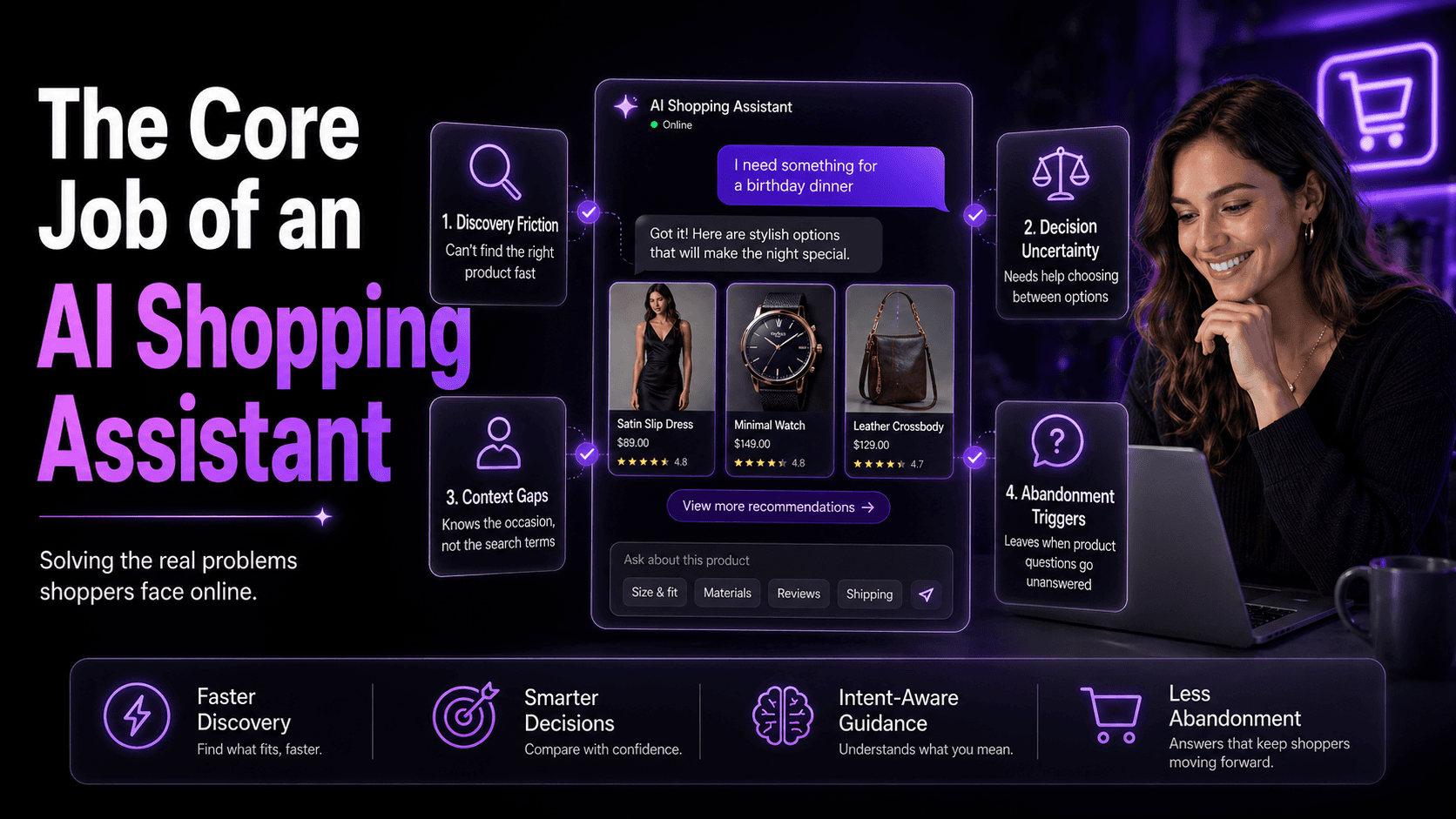
An AI shopping assistant exists to solve four specific problems that standard ecommerce experiences create:
Discovery friction: Shoppers who cannot find what they are looking for through search or category navigation
Decision uncertainty: Shoppers who have found options but need guidance to choose
Context gaps: Shoppers who know what occasion or need they are shopping for but cannot translate it into search terms
Abandonment triggers: Shoppers who have intent but hit an unanswered question at the product page stage and leave rather than searching for the answer
Why AI Shopping Assistants Outperform Traditional Chatbots
The word "chatbot" carries baggage from a decade of scripted, frustrating experiences. Understanding what has changed in 2026 is essential before evaluating any solution in this category.
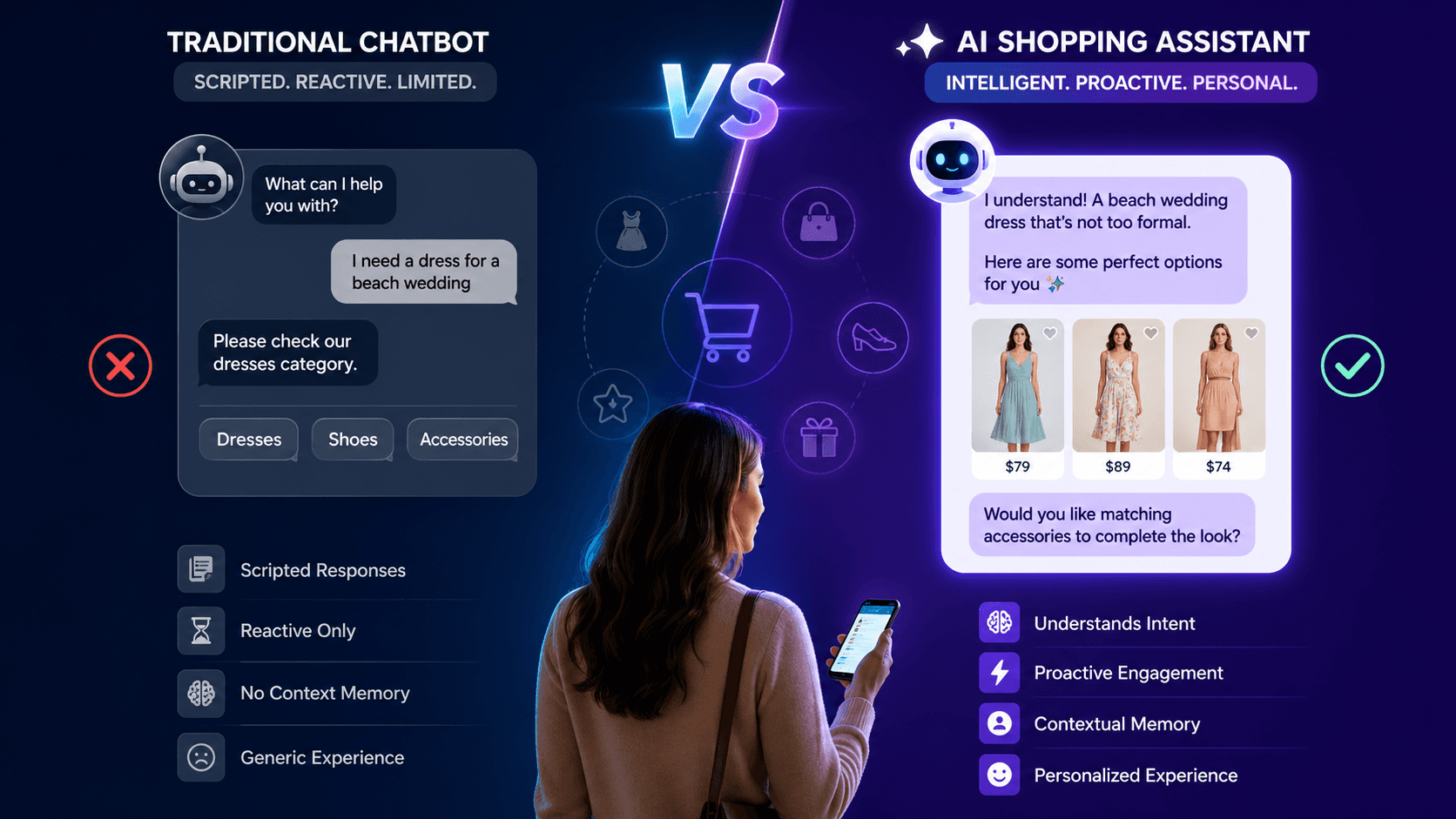
Script-Based vs. Intelligence-Based
Traditional chatbots respond to keywords with pre-written answers. They work well for high-volume repetitive queries like "where is my order" or "what is your returns policy." They fail immediately when a shopper's question requires understanding context, intent, or product knowledge.
AI shopping assistants use natural language processing to understand what the shopper actually means, not just the words they used. A shopper who types "something for a beach wedding that is not too formal" should receive a specific outfit suggestion. A keyword-matching bot would either produce a generic response or return zero matches.
Reactive vs. Proactive Engagement
Traditional chatbots wait to be activated. AI shopping assistants can proactively engage based on behavioral signals: time on page, scroll depth, exit intent, cart abandonment indicators, or repeated visits to the same product category.
A shopper who has viewed the same jacket three times in 10 minutes is showing strong purchase intent with a hesitation signal. An AI assistant that recognizes this and proactively opens with "I noticed you have been looking at this jacket. Would it help to see how it works as part of a complete outfit?" turns a likely abandonment into a likely sale.
Pro Tip: Configure your AI shopping assistant to trigger on behavioral signals, not just on manual activation. The highest-converting deployments engage shoppers before they reach the point of abandonment, not after.
Static vs. Contextual Memory
Leading AI shopping assistants in 2026 maintain context across a session, and increasingly across sessions. A returning shopper who previously bought a formal suit and now asks for "something for a more relaxed occasion" should receive suggestions that acknowledge their style profile and purchase history, not generic results.
This contextual persistence is what makes the difference between an assistant that feels helpful and one that feels like starting over every time.
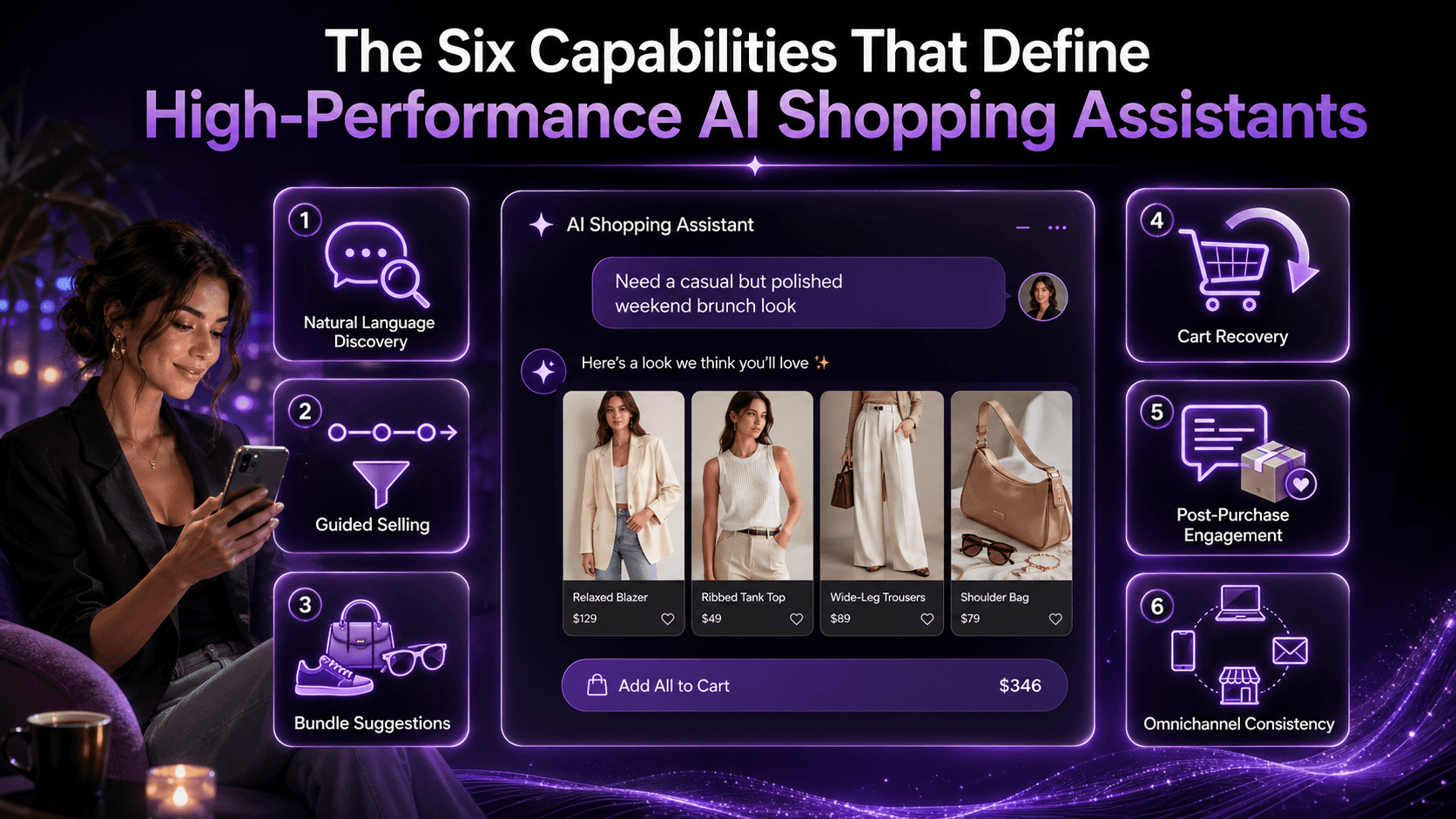
The Six Capabilities That Define High-Performance AI Shopping Assistants
Not all AI shopping assistants deliver equal results. These six capabilities separate the tools that move revenue from those that produce marginal lift.
1. Natural Language Product Discovery
The assistant must be able to interpret free-form, conversational search queries and return relevant products accurately. This goes well beyond keyword matching.
A shopper asking "what would work for a casual but polished look for a weekend brunch?" is providing a rich set of signals: occasion, aesthetic register, setting, and time context. An AI assistant that processes all of these and returns a curated set of relevant items is doing genuine discovery work. One that returns results for "brunch" or "casual" alone is not.
Visual search boosts conversion rates by 27% in categories where it is deployed, according to Clothing Brands' research. The most capable AI shopping assistants combine text, visual, and voice inputs into a single discovery layer.
2. Guided Selling Flows
Over 70% of shopper queries focus on product validation, including compatibility, usage, or fit, because shoppers use AI to build buying confidence, not just to find products, according to Retainful's analysis of Zoovu's 2026 benchmark data.
A strong AI shopping assistant can guide a shopper through a structured but conversational selection process. "What is the occasion?" leads to "What aesthetic are you going for?" which leads to "What is your budget?" which leads to a specific, confident recommendation. This guided selling flow reduces decision fatigue and produces significantly higher basket confidence than open-ended browsing.
Officeworks used a guided selling flow for laptop selection, asking about intended use cases, which increased click-through rates by 19% through more relevant tailored recommendations, according to Retainful's benchmark analysis.
3. Real-Time Outfit and Bundle Suggestions
For fashion, lifestyle, home, and beauty brands, the ability to suggest complementary products in context is one of the highest-AOV capabilities an AI assistant can deliver.
When a shopper adds a dress to their cart, the assistant should be able to suggest shoes, a bag, and jewelry that complete the look for the occasion they mentioned earlier in the conversation. These suggestions should be informed by the session context, not just by generic cross-sell rules.
Customers engaging with AI chat features show 25% higher average order value than those who shop without guidance, according to Envive AI's AOV research. The contextual bundle suggestion is the primary mechanism behind this uplift.
4. Abandoned Cart Recovery
AI shopping assistants that engage proactively at cart abandonment signals recover a measurably higher proportion of at-risk sessions than static recovery emails.
Proactive AI chat recovers 35% of abandoned carts through timely intervention and personalized offers, according to Anchor Group's 2026 ecommerce AI statistics. An assistant that can recognize when a shopper is preparing to leave and open with a specific, relevant question about what is stopping them from completing the purchase converts abandonment signals into conversations that often result in completed transactions.
Pro Tip: Train your AI shopping assistant with the three most common pre-purchase objections in your specific product category. A fashion assistant should be ready to address fit uncertainty, styling questions, and occasion suitability. A home decor assistant should address size, style compatibility, and delivery timing.
5. Post-Purchase Engagement
The most underused capability of AI shopping assistants is what happens after the purchase. A customer who just bought a summer dress and receives a follow-up from the assistant suggesting complementary sandals and accessories is in an ideal state to buy more. They are satisfied from the first purchase, familiar with the assistant, and still in a positive emotional context around the brand.
79% of brands report that AI-driven conversational commerce has increased sales, with much of that lift coming from post-purchase engagement flows, according to Daily AI Mail's 2026 ecommerce statistics.
6. Omnichannel Consistency
A shopper who engages with your AI assistant on the website should encounter the same intelligence when they open your email, visit your app, or interact with your in-store team. Context should not reset between channels.
Shoppers who engage with AI across multiple channels convert at significantly higher rates and show substantially higher lifetime value than single-channel engaged shoppers. The assistant's understanding of a shopper's preferences, purchase history, and session context should follow them wherever they engage with the brand.
Understanding how AI supports customer engagement across retail channels shows why channel consistency is not a technical luxury but a commercial requirement for brands serious about AI-driven growth.
Real-World Results: What Brands Are Seeing in 2026
McKinsey's Global Lifestyle Brand Case Study
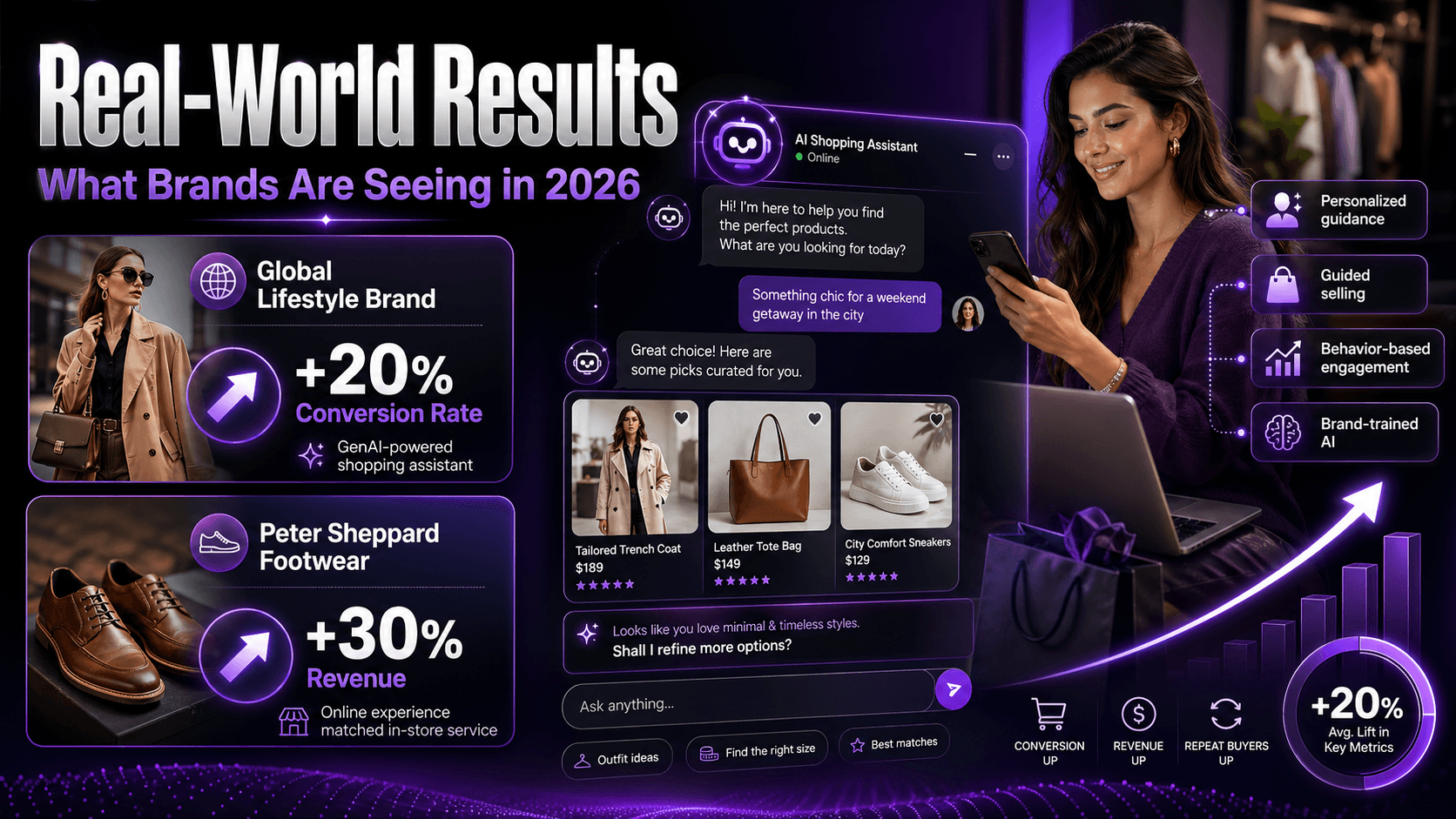
A global lifestyle brand developed a GenAI-powered shopping assistant that drove a 20% increase in conversion rates, according to Shopify's 2026 AI in retail guide. The assistant's ability to translate the brand's product expertise into personalized, conversational guidance directly addressed the discovery gap that was previously costing conversion at the product page stage.
Expert Note: The lifestyle brand's results came not from deploying a chatbot but from deploying a trained AI assistant that understood the brand's product catalog, voice, and customer context. Generic AI tools produce generic results. AI shopping assistants trained on specific product knowledge and brand tone consistently outperform off-the-shelf solutions.
Peter Sheppard Footwear: From Online to In-Store Parity
Peter Sheppard Footwear added an AI chatbot to their Shopify store with the specific goal of matching the service quality of their physical locations. The result was a 30% increase in revenue, according to Shopify's retail AI guide. Their insight was that the barrier to online conversion was not product quality or pricing. It was the absence of the knowledgeable sales associate experience that their physical stores delivered as a matter of course.
This case study is instructive because it names the real problem most ecommerce brands have. The store experience and the digital experience are not equivalent. AI shopping assistants close that gap by bringing the sales associate intelligence online.
Expert Note: Peter Sheppard's 30% revenue lift came from a relatively straightforward chatbot implementation. Brands deploying more sophisticated AI assistants with outfit recommendation, behavioral trigger engagement, and guided selling flows consistently see higher returns. The benchmark is achievable with basic implementation. The ceiling is much higher.
How to Choose the Right AI Shopping Assistant for Your Store
The market has expanded significantly in the past 18 months. Here is a practical evaluation framework based on what actually differentiates high-performing solutions from average ones.
Evaluate Training Quality
An AI shopping assistant is only as good as the product knowledge it is trained on. Ask every vendor how their system processes your product catalog, and specifically how it handles edge cases like new products without behavioral data, products with limited descriptions, and out-of-stock alternatives.
A system trained on sparse product data will produce weak recommendations. A system trained on rich, structured product data with occasion tags, aesthetic descriptors, and complementary item mapping will produce recommendations that feel genuinely curated.
Test Conversation Quality Under Real Conditions
Before any deployment decision, test the assistant with the actual questions your customers ask most frequently. Use your support ticket history, your most common search queries, and the questions your in-store team handles daily.
A scripted demo will always perform well. An assistant handling your real customer language, with your actual product catalog, under the varied and imprecise conditions of real shoppers, is the only valid test.
Assess Behavioral Trigger Capabilities
The difference between an AI assistant that waits to be activated and one that engages proactively at behavioral inflection points is significant. Confirm whether the solution can trigger on:
Exit intent signals
Extended time on product page without cart add
Repeated visits to the same category
Cart abandonment without purchase initiation
Return visitor recognition
Confirm Omnichannel Architecture
If your goal is a consistent AI-assisted experience across website, mobile app, email, and in-store, confirm that the solution supports unified customer profiles and can maintain context across sessions and channels. Single-channel solutions that require re-engagement from scratch on every new touchpoint will underperform in any omnichannel environment.
How PaletteAI's Styling Assistant Delivers Guided Discovery at Scale
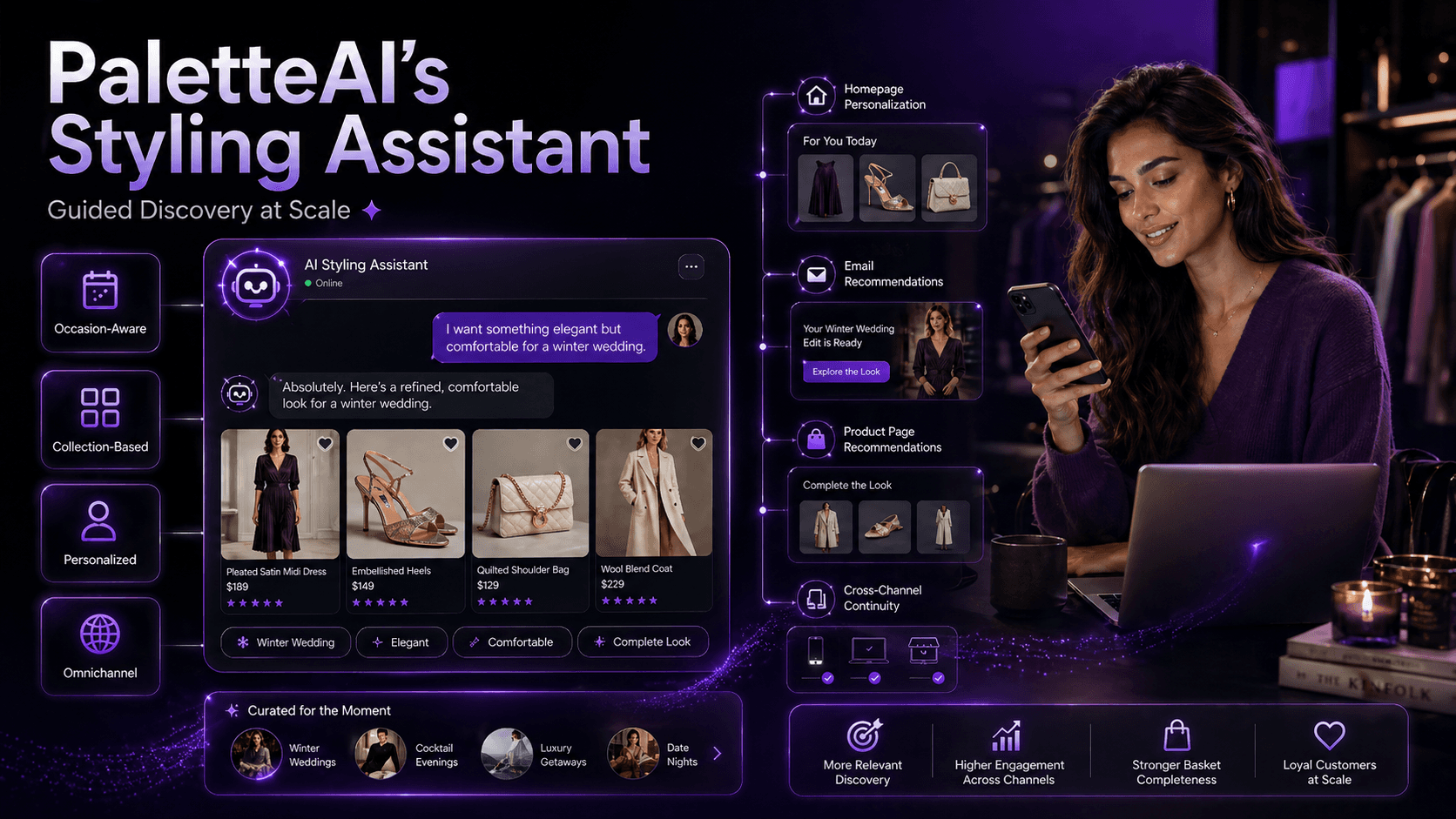
PaletteAI's Styling Assistant is built specifically for retail and lifestyle brands where purchase decisions are driven by taste, occasion, and context rather than specification. It addresses each of the six capability areas above with a specific, documented approach.
It engages shoppers through natural conversation about their specific need, occasion, or preference. A shopper who says "I want something elegant but comfortable for a winter wedding" receives a curated selection of pieces with a brief explanation of why each one works for the occasion, not a generic search result.
The Styling Assistant surfaces not just products but complete ideas. When a shopper engages, they are guided through a discovery journey that builds a multi-item collection around their context. This collection-based approach is directly connected to how narrative-led buying and curated collections drive higher basket sizes in categories where style and occasion context determine purchase decisions.
Its recommendations are grounded in PaletteAI's Curated Collection Engine, which means every product the Styling Assistant suggests is placed within a story context, not just a cross-sell logic. The shopper understands not just what the assistant is recommending but why those specific items work together for their stated occasion.
The Styling Assistant also connects to personalized retail discovery by feeding each shopper's session context back into the personalization layer. What the shopper revealed in conversation informs what they see on the homepage on their next visit, which collection email they receive, and which recommendations appear on their next product page. The conversation is not a standalone interaction. It is an input to a longer-term personalization relationship.
For retailers evaluating virtual shopping assistants in retail, the key differentiator of PaletteAI's Styling Assistant is that it operates within a complete discovery architecture rather than as a standalone widget. The conversation connects to collections, recommendations, post-purchase follow-up, and omnichannel personalization in a way that isolated chatbot deployments cannot replicate.
This means every conversation the Styling Assistant has contributes to both an immediate sale and a longer-term customer relationship. The shopper who was guided to a complete outfit for a wedding this month is a shopper whose style profile is now known well enough to curate something relevant for them when party season arrives.
How to Measure AI Shopping Assistant Performance
Deploying an AI shopping assistant without a measurement framework means operating without feedback. These metrics tell you what is working, what needs adjustment, and where the largest remaining opportunities are.
Assisted conversion rate: The percentage of shoppers who engage with the assistant and complete a purchase. Compare this against the unassisted conversion rate. The gap between these two numbers is the documented value the assistant is adding.
Average order value for assisted sessions: Compare the AOV of sessions with assistant engagement against those without. A well-deployed AI shopping assistant should show measurably higher AOV due to outfit suggestions, curated collections, and contextual cross-sells.
Cart abandonment rate for assistant-engaged shoppers: If the assistant is performing proactive abandonment recovery effectively, engaged shoppers should abandon at a lower rate than non-engaged ones.
Conversation-to-product-page rate: What percentage of conversations result in a shopper navigating to a product page? This metric tells you whether the assistant's product suggestions are relevant enough to generate interest.
Return rate for assistant-guided purchases: Shoppers who buy after receiving genuine guided assistance make more informed decisions and return at lower rates. Tracking this over 30 and 90 days validates the pre-purchase guidance quality of the assistant.
Pro Tip: Run a 30-day A/B test with and without assistant engagement on your highest-traffic product categories. Measure conversion rate, AOV, and abandonment rate separately for each group. This gives you clean, defensible data on the revenue impact that you can use to justify expanded deployment.
Frequently Asked Questions
Q: What is an AI shopping assistant for ecommerce? An AI shopping assistant is a conversational AI system embedded in an ecommerce store that guides shoppers through product discovery, helps them evaluate options, and assists them in making confident purchase decisions through natural language conversation. Unlike traditional chatbots, AI shopping assistants use language models to understand shopper intent in context, generate relevant product suggestions, and engage proactively at key decision moments rather than waiting to be activated.
Q: How much does an AI shopping assistant improve ecommerce conversion rate? Shoppers who engage with an AI shopping assistant convert at 12.3% compared to 3.1% for those who shop without assistance, a four-times conversion improvement, according to Rep AI data. Shoppers also complete purchases 47% faster when assisted by AI, reducing friction at the decision stage. A global lifestyle brand reported a 20% conversion rate increase after deploying a GenAI-powered shopping assistant, and Peter Sheppard Footwear saw a 30% revenue increase from their implementation.
Q: What is the difference between an AI shopping assistant and a chatbot? A chatbot operates on scripted decision trees and responds to keywords with pre-written answers. An AI shopping assistant uses natural language processing to understand shopper intent in context, generate dynamic responses, and guide product discovery through conversation. Chatbots handle high-volume repetitive queries well. AI shopping assistants handle complex, context-dependent purchase guidance that scripted systems cannot replicate.
Q: Which ecommerce categories benefit most from AI shopping assistants? Fashion, beauty, lifestyle, home decor, gifting, and accessories see the highest impact because purchase decisions in these categories are driven by taste, occasion, and context rather than specification. Shoppers in these categories frequently have a need they cannot express as a precise search query, which is exactly the gap that conversational AI fills. Electronics and high-consideration purchases also benefit significantly from guided selling flows that translate specifications into practical use-case recommendations.
Q: How do I know if my ecommerce store is ready to deploy an AI shopping assistant? Your store is ready if you have a structured product catalog with sufficient descriptive data, a meaningful volume of monthly traffic to generate usable interaction data, and a clear understanding of the most common questions your shoppers have before purchasing. If your support team regularly receives the same pre-purchase questions about fit, occasion suitability, product combinations, or compatibility, those questions are exactly what an AI shopping assistant should be answering at scale, before the shopper considers leaving.
Conclusion
Three takeaways define the AI shopping assistant opportunity in 2026.
First, the conversion gap between assisted and unassisted shopping is now four times. That is not a marginal performance difference. It is a structural advantage available to any brand willing to invest in genuine AI-powered guidance.
Second, the category has moved well beyond scripted chatbots. The AI shopping assistants generating measurable revenue impact in 2026 combine natural language understanding, behavioral trigger engagement, contextual product knowledge, and session memory in ways that feel genuinely helpful rather than mechanically responsive.
Third, the highest-performing deployments treat the AI assistant as part of a connected discovery architecture, not as a standalone widget. When the conversation informs the homepage personalization, the email recommendations, and the next-session experience, the value compounds across the full customer lifetime rather than appearing only in single-session metrics.
PaletteAI's Styling Assistant brings all of this together for retail and lifestyle brands. Guided discovery. Story-driven collections. Contextual outfit recommendations. Omnichannel personalization continuity.
See PalatteAI in Action to see what guided AI-powered shopping assistance looks like for your specific catalog and your customers.
Sources and Citations
Anchor Group: AI in E-Commerce: 16 Key 2026 Trends and Stats
Neuwark: AI Chatbots for Ecommerce: Complete 2026 Guide to Conversational Selling
Retainful: AI in Ecommerce Conversion: 5 Takeaways from the 2026 Benchmark Report
Shopify: AI in Retail: 10 Use Cases and an Implementation Guide 2026
ContactPigeon: Top Retail Predictions in 2026: How AI Is Reshaping Commerce
Capital One Shopping: AI Shopping Statistics 2026: Consumer Adoption
Daily AI Mail: AI in Ecommerce Statistics 2026
InsiderOne: AI in E-Commerce: 7 Ways It Is Redefining Shopping in 2026
Envive AI: 39 Average Order Value Boost Statistics 2026
Clothing Brands: 75+ AI Fashion Personalization Statistics 2026