
The 6 Biggest Pain Points Destroying E-commerce Revenue and How AI Solves Each One

Product Marketing strategist



Key Takeaways:
Six structural pain points, including broken search, poor discovery, manual merchandising, scaling support, low AOV, and lack of personalization, are responsible for the majority of lost e-commerce revenue.
Each pain point has a direct AI solution inside the GenAIEmbed platform: Lexiconne (search), Palette (collections), and Expert Agent (support).
Retailers deploying GenAIEmbed see measurable results within 30-60 days without replacing existing commerce infrastructure.
The platform integrates via API in approximately four weeks. No internal AI team required.
Why E-commerce Revenue Leaks Are Getting Worse, Not Better
Most U.S. e-commerce leaders are optimizing the wrong things. They invest in traffic, paid media, and platform upgrades while the core revenue leak continues unaddressed inside the shopping experience itself.
The problem is not that customers are not arriving. The problem is what happens after they arrive.
Shoppers land on your store with clear purchase intent. They search. They browse. They encounter friction. And they leave, often for a competitor whose store understands them better.
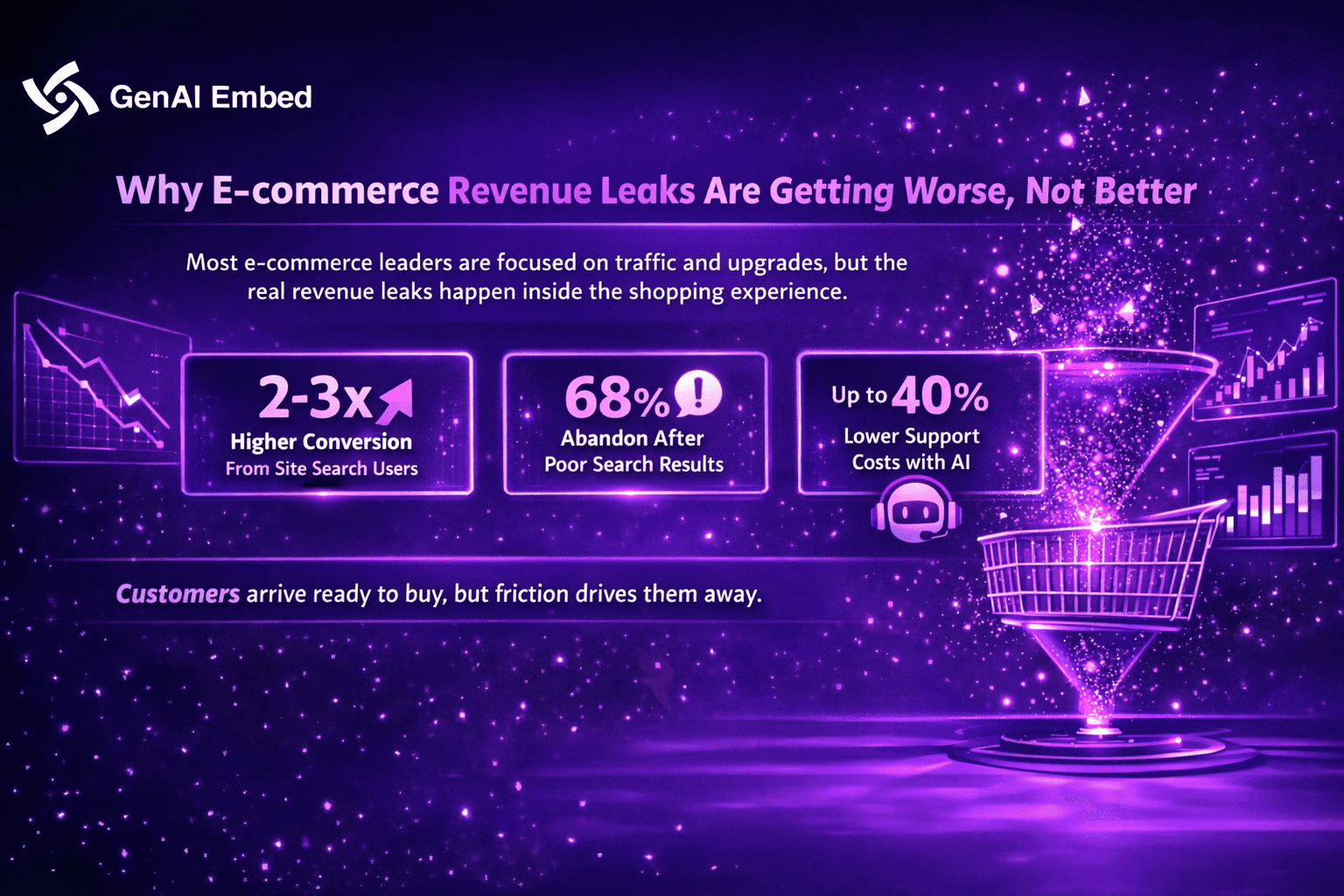
Site search users convert 2-3x more often than shoppers who don't use search
68% of online shoppers abandon a site after a poor search result experience
AI-assisted customer service can reduce support costs by up to 40%
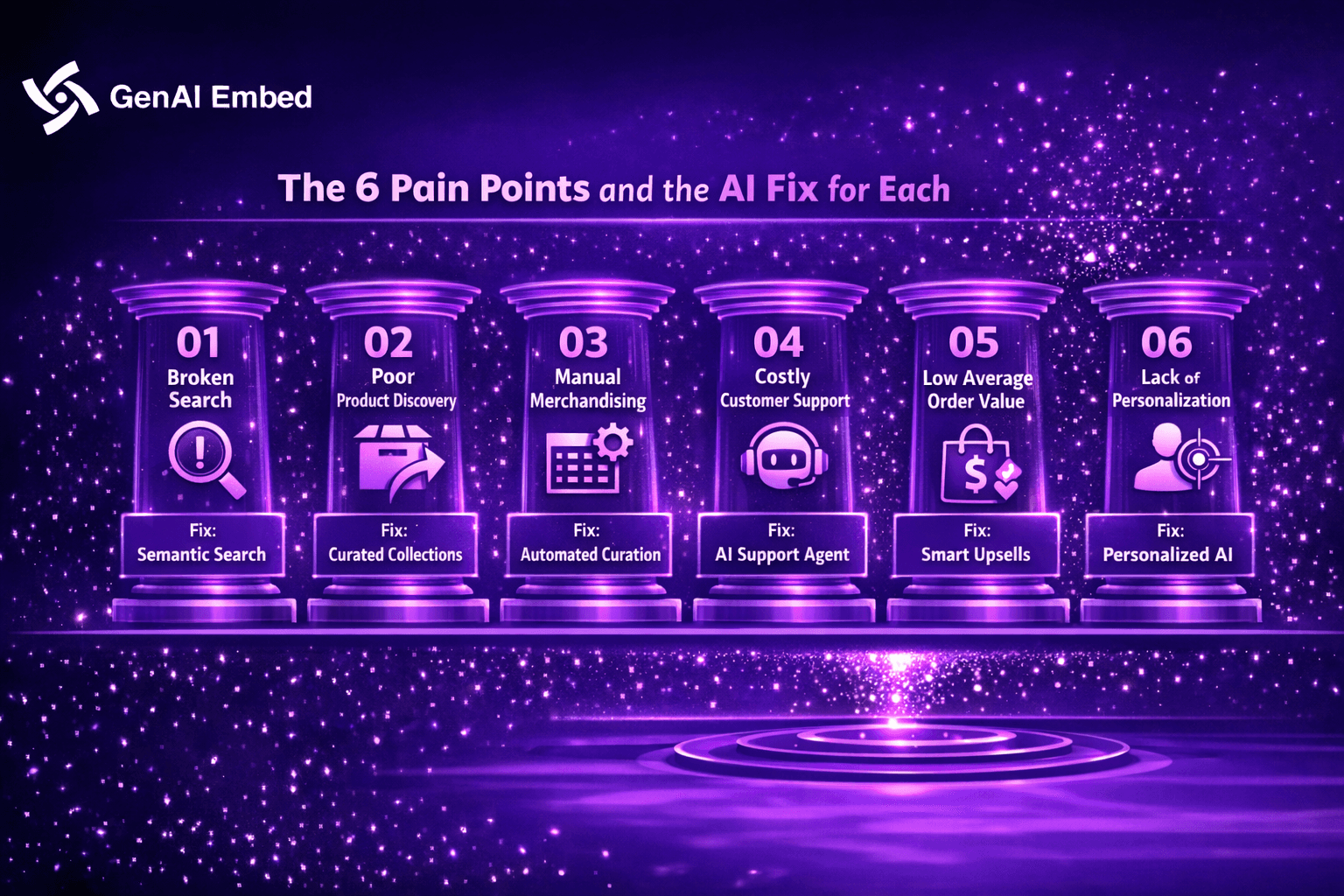
The six pain points below account for the majority of revenue lost at the discovery, engagement, and support layers of the e-commerce funnel. Each one has a direct AI solution.
The 6 Pain Points and the AI Fix for Each
PAIN POINT 01 - Broken Product Search Kills Conversion Before It Starts
Site search is the highest-intent interaction on any e-commerce store. A shopper who types a query is ready to buy, but only if the results are relevant. Yet most retail search tools still operate on keyword matching, which fails the moment a shopper uses natural language.
The Pain:
Shoppers search "cozy winter jacket" and the system returns generic "jacket" results with no warmth filtering
Natural language queries return zero or irrelevant results
Product titles don't match how customers actually describe what they want
Search exit rates climb and shoppers leave without purchasing
High-intent traffic converts at the same rate as accidental traffic
The GenAIEmbed Fix:
Lexiconne semantic search understands intent and context, not just keywords
Natural language queries like "minimalist sneakers not white" return relevant, filtered results
Meaning-based matching surfaces products even when titles don't match search terms
Zero-result pages are dramatically reduced across the catalog
Outcome: Shoppers who find what they want quickly are 2-3x more likely to complete a purchase. Lexiconne closes the gap between how shoppers search and how products are cataloged. Pilot deployments show an 11% average conversion uplift and 80% reduction in search exit rate.
PAIN POINT 02 - Shoppers Cannot Discover Relevant Products Beyond the First Page
Most retail catalogs contain thousands of relevant products that shoppers never see. Poor navigation, flat category structures, and generic sorting algorithms bury inventory that customers would buy if they knew it existed.
The Pain:
Shoppers browse only the top few search results and leave
Relevant inventory sits undiscovered in deep catalog pages
Category structures reflect internal product logic, not how customers think
Cross-sell and upsell opportunities are invisible to the average shopper
Discovery is passive. The store lists products but does not guide customers
The GenAIEmbed Fix:
Lexiconne surfaces contextually relevant products across the entire catalog depth
Palette creates curated discovery journeys organized around customer situations
Collections like "Weekend Travel Essentials" guide exploration across multiple categories
Related products surface within narrative contexts, not just sidebar widgets
Outcome: AI-guided discovery converts passive browsing into active exploration. Retailers report meaningful increases in pages-per-session and add-to-cart events when curated discovery paths replace flat category browsing.
PAIN POINT 03 - Manual Merchandising Cannot Keep Pace with Catalog Scale
Mid-to-large U.S. retailers routinely manage 50,000 to 500,000 SKUs. Manually curating product collections, updating bundles, and refreshing cross-sell logic at this scale is economically unfeasible and leaves most of the catalog commercially invisible.
The Pain:
Merchandising teams spend weeks manually building and updating product collections
Most SKUs never appear in curated collections or recommended sections
Seasonal refreshes lag behind real consumer demand trends
Bundling logic is static and does not adapt to shopper behavior or inventory shifts
Human curation capacity maxes out at a fraction of the total catalog
The GenAIEmbed Fix:
Palette automatically generates thematic collections from existing catalog data
Collections are built around customer situations: home office setups, weekend looks, skincare routines
New collections are generated and updated dynamically with no manual input required
The entire catalog depth becomes commercially reachable, not just top-listed SKUs
Outcome: Palette turns the entire catalog into a merchandised asset. Every SKU gets a chance to surface in the right collection at the right moment. Pilot deployments report a 15-30% increase in average order value.
PAIN POINT 04 - Customer Support Costs Scale Faster Than Revenue
The majority of retail customer service tickets are repetitive and answerable: order status, sizing guidance, product care, compatibility, and return policies. Staffing human agents to handle this volume is expensive, slow, and a poor use of team capacity.
The Pain:
Support teams spend 60-70% of their time on repetitive, low-complexity tickets
Response wait times frustrate customers during peak seasons
Scaling support headcount to meet demand is cost-prohibitive
Agents lack product-specific depth across a large, changing catalog
Support costs grow linearly with order volume and margins compress at scale
The GenAIEmbed Fix:
Expert Agent handles repetitive queries 24/7: order tracking, sizing, care instructions, compatibility
Answers are drawn from verified product documentation, not hallucinated responses
Trained on retail-specific domains: apparel, furniture, beauty, and home goods
Human agents are freed for complex, high-value customer interactions
Outcome: Expert Agent decouples support cost from order volume. As the business grows, AI handles an increasing share of routine inquiries. Deployments show up to 40% reduction in support operational costs and 20-35% improvement in CSAT scores.
PAIN POINT 05 - Average Order Value Stays Flat Despite a Large Catalog
Most shoppers purchase a single item per session despite the catalog containing dozens of complementary products they would buy if shown correctly. The problem is not the catalog. It is the lack of contextual, intelligent presentation that connects products to the full picture a customer is building.
The Pain:
Cross-sell widgets show generic "customers also bought" suggestions with poor relevance
Products are presented in isolation, not as part of a coherent customer situation
Shoppers don't discover complementary items because they aren't surfaced contextually
Bundle recommendations are static and not updated to reflect trends or inventory
Revenue per session underperforms relative to catalog size
The GenAIEmbed Fix:
Palette builds narrative collections that present products as complete solutions
"Minimalist Living Room Setup" sells a rug, side table, lamp, and cushions together
Contextual presentation makes upsell feel like helpful guidance, not a sales push
Collections update dynamically to reflect trending combinations and available inventory
Outcome: When customers see products as part of a complete picture rather than isolated items, basket size increases naturally. Palette creates the merchandising context that turns single-item purchases into multi-item sessions, with a 15-30% AOV uplift reported in pilot programs.
PAIN POINT 06 - The Personalization Gap: One-Size-Fits-All Stores Losing to Smarter Competitors
Consumer expectations for personalization have been shaped by Amazon, Netflix, and Spotify. Shoppers now expect online stores to understand their intent, adapt to their context, and surface relevant products without manual filtering. Most retail tech stacks were never built to deliver this and the gap is widening.
The Pain:
Every shopper sees the same generic homepage, search results, and recommendations
No differentiation between a first-time visitor and a repeat high-LTV customer
Search results don't adapt to session context or browsing behavior
Competitors with AI-native stacks are delivering meaningfully better experiences
Churn increases as customers migrate to stores that understand them better
The GenAIEmbed Fix:
Lexiconne interprets each query with contextual intelligence, not one-size-fits-all ranking
Palette creates thematic discovery paths that adapt to catalog and trend signals
Expert Agent delivers personalized product guidance based on specific customer queries
The full platform operates as an intelligent layer over existing commerce infrastructure
Outcome: AI-native shopping experiences are no longer a differentiator. They are the expectation. GenAIEmbed gives mid-to-large retailers the personalization intelligence of enterprise-grade platforms without rebuilding their entire stack. Most deployments show measurable lift across conversion, AOV, and CSAT within 30-60 days.
Pain Point to Solution to Result: The Full Picture
Pain Point | GenAIEmbed Engine | Timeline | Measured Outcome |
|---|---|---|---|
Broken product search | Lexiconne - Semantic Search | Week 1-2 | +11% conversion / -80% search exit rate |
Lexiconne + Palette | Week 2-4 | Higher pages/session, more add-to-cart | |
Manual merchandising bottleneck | Week 3-4 | Full catalog commercially reachable | |
Scaling support costs | Expert Agent - AI Retail Assistant | Week 2-4 | -40% support costs / +20-35% CSAT |
Low average order value | Week 3-4 | +15-30% AOV uplift | |
Personalization gap | 30-60 days | Measurable lift across all KPIs |
How Fast Can These Pain Points Be Fixed?
One of the most common concerns retail executives raise is implementation complexity. Based on past enterprise software experiences, most teams expect meaningful AI infrastructure to take 6-12 months to deploy.
GenAIEmbed is structured differently. As an API-first platform, it adds an intelligence layer to existing commerce infrastructure rather than replacing it.
Standard Deployment Timeline:
Week 1: Catalog data ingestion and API connection to existing commerce platform
Week 2: Lexiconne semantic search live in production. Improvements begin immediately.
Week 3: Palette collection engine configured. First AI-curated collections go live.
Week 4: Expert Agent trained on product documentation. 24/7 support automation active.
Day 30+: First measurable performance data available across all three engines
No internal AI team required. No existing platform replaced. Shopify, Salesforce Commerce Cloud, Magento, and custom infrastructure are all supported.
Frequently Asked Questions
What are the most common pain points in e-commerce that AI can solve? The six most common are: broken product search, poor product discovery, manual merchandising bottlenecks, scaling customer support costs, low average order value, and the personalization gap. GenAIEmbed's three engines, Lexiconne, Palette, and Expert Agent, are each designed to address one or more of these areas directly.
How does AI fix broken product search in e-commerce? AI fixes broken product search by replacing keyword matching with semantic search, which understands the intent and meaning behind shopper queries. GenAIEmbed's Lexiconne engine uses this approach, reducing search exit rates by up to 80% and increasing conversion rates by approximately 11%.
What is the ROI of AI-powered product discovery for retail? The ROI includes a 10-15% conversion rate uplift from semantic search, a 15-30% increase in average order value from AI-curated collections, and up to 40% reduction in customer support costs. Most retailers see positive ROI within 60-90 days of deployment.
How does AI reduce customer support costs in retail? By automating responses to high-volume, repetitive inquiries using verified product documentation. GenAIEmbed's Expert Agent deflects the majority of routine tickets from human agents, reducing operational support costs by up to 40% and improving CSAT scores by 20-35%.
How long does it take to see results from an AI e-commerce platform? Most retailers see initial improvements within 30 days. Search quality improvements from Lexiconne are visible within the first two weeks. Collection and support performance data follow within the first full month.
Do I need to replace my existing e-commerce platform to use GenAIEmbed? No. GenAIEmbed connects to existing catalog systems, CRM tools, and commerce engines including Shopify, Salesforce Commerce Cloud, and Magento, without requiring a platform migration.
What is the difference between AI product recommendations and AI collection curation? Recommendations surface individual items based on behavioral signals. Collection curation groups products into themed, narrative-driven experiences organized around customer situations, like "Home Office Setup" or "Sustainable Travel Collection." Curated collections consistently drive higher AOV because they present products as complete solutions, not isolated items.
Which of These Pain Points Is Costing Your Business the Most?
Every e-commerce business carries at least two or three of the six pain points described in this article. The question is not whether they exist. It is how much revenue they are costing per month and how quickly they can be addressed.
GenAIEmbed was built specifically for U.S. retailers who need measurable improvements in search quality, product discovery, and customer support, without rebuilding their commerce stack or hiring an AI team.
Ready to identify your highest-impact pain point? Schedule a GenAIEmbed Product Discovery Audit, a no-cost evaluation of where your store is losing the most revenue at the discovery, engagement, and support layers.
Book Your Free Audit at genaiembed