
Product Page Conversion Rate Optimization for Ecommerce

Product Marketing strategist
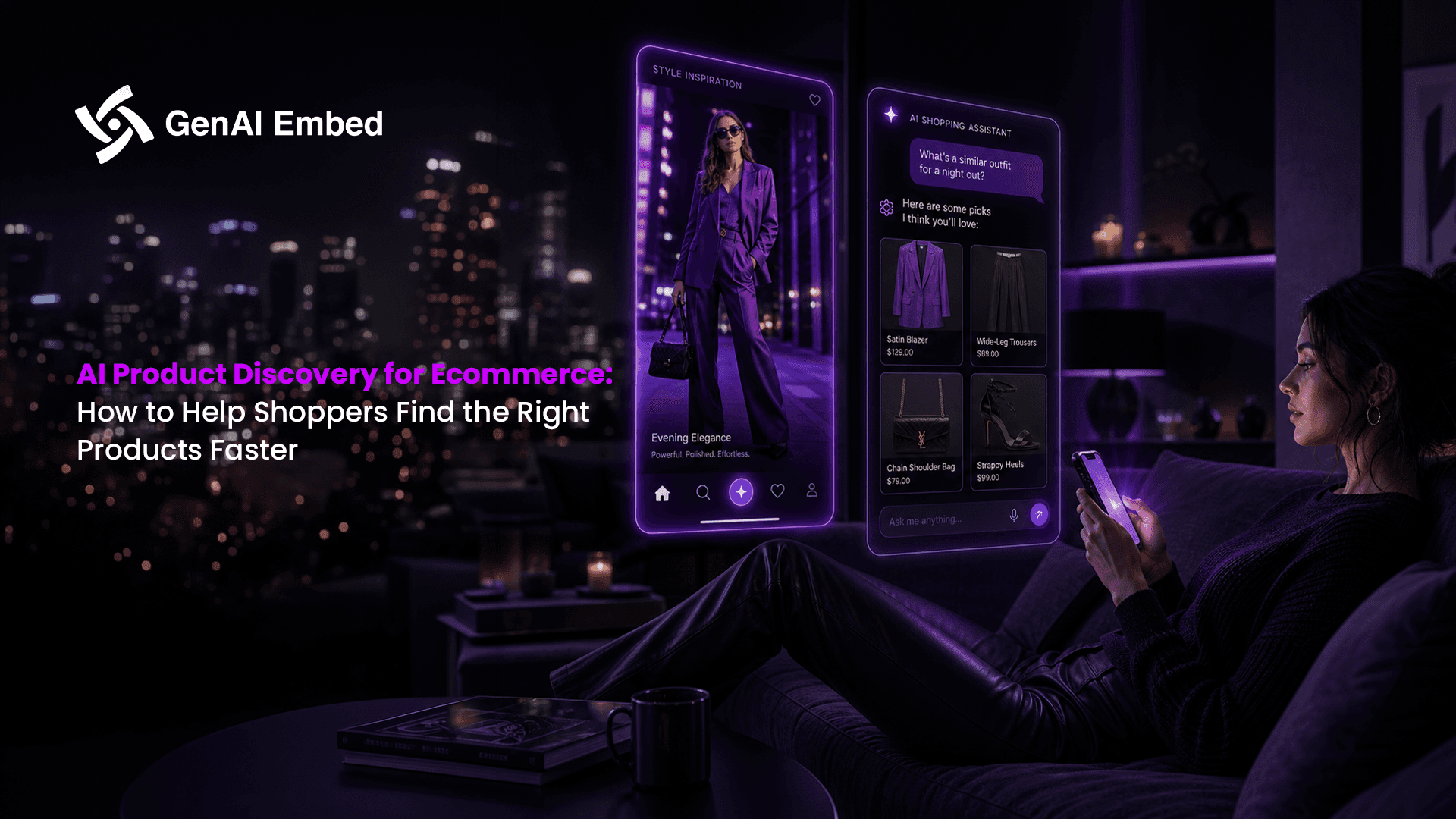


Your product page is the most important real estate in your ecommerce store.
It is the moment a shopper decides whether to buy or bounce. Everything before it, every ad, every search result, every social post, was designed to get them here. And yet most product pages fail at the one job they exist to do.
The average ecommerce store converts at just 1.9% globally. The top 10% of stores convert at 4.7% and above, according to SQ Magazine's 2026 ecommerce conversion benchmarks. The difference between these two groups is not traffic volume. It is not product quality. It is how well the product page builds confidence, removes uncertainty, and guides the shopper to a decision.
In this guide, you will learn the ten highest-impact strategies to improve your product page conversion rate in 2026, the data behind each one, real brand examples, and how AI-powered discovery and personalization are reshaping what a high-converting product page looks like.
By the end, you will know exactly what to fix, where to start, and how platforms like PaletteAI help retail brands close the gap between browsers and buyers directly on the product page.
Why Most Product Pages Fail to Convert
Before optimizing, it helps to understand exactly why product pages lose shoppers.
The problem is rarely the product itself. Shoppers who land on a product page typically arrived with some level of intent. They clicked a link, an ad, or a search result that referenced the product specifically. They are already interested.
What kills conversion at the product page stage is unresolved uncertainty.
The shopper has a question they cannot answer. Does this fit the occasion I have in mind? Does it come in a different option? What does it look like in real life versus a studio photo? What do other shoppers who bought this say? Does it work with what I already own? Is this the right one, or is there a better option?
Generic product pages do not answer these questions. They show a product name, a price, a few images, a description, and a button. The shopper is left to resolve their uncertainty alone. Many do not bother, and they leave.
Products with just five reviews are 270% more likely to be purchased than products with none, according to WordStream's 2026 CRO statistics. Ecommerce brands optimizing product pages with high-quality imagery see conversion lifts of up to 40%, according to SQ Magazine.
The opportunity is not to show a better product. It is to build more confidence around the product you already have.
The 10 Highest-Impact Strategies to Improve Product Page Conversion Rate
1. Lead With High-Quality Visual Content That Answers Real Questions
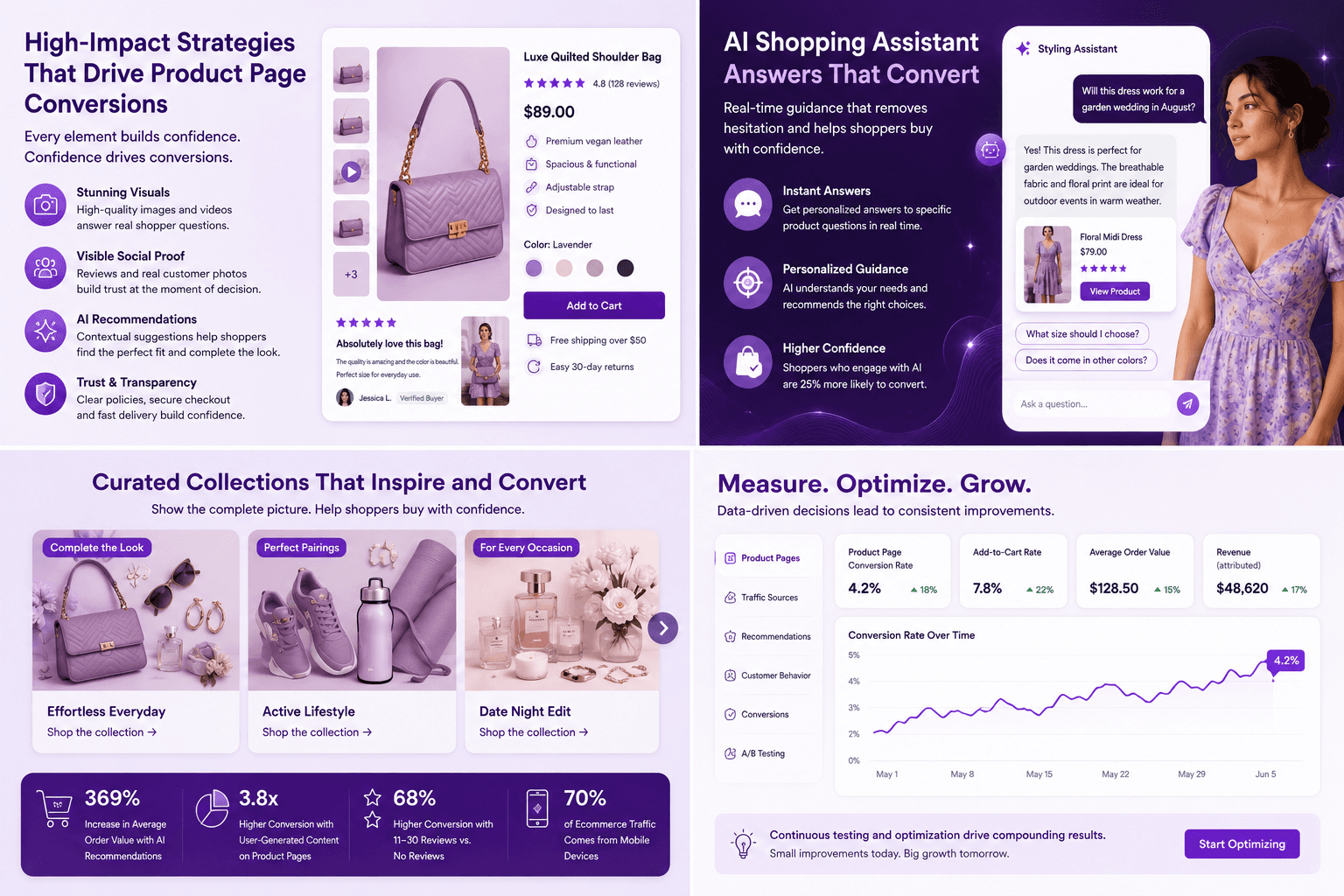
Baymard Institute research reveals that 56% of shoppers immediately explore product images after arriving on a product page. Images are not decoration. They are the first and most-used decision-making tool on your product page.
The brands achieving the highest product page conversion rates use visual content that answers the questions shoppers actually have:
How does this look in real life, not a studio?
How does it fit on a real person?
What is the scale and proportion?
What does the texture, material, or finish actually look like up close?
How does it work or function in context?
Video content takes this further. Product videos increase conversion rates by 144%, according to Ringly.io's 2026 ecommerce CRO guide. A 30-second styling video for a fashion product answers questions that 12 static images cannot.
User-generated content is the strongest visual trust signal available. UGC can increase conversion rates by up to 200%, according to Yotpo data cited by Ringly.io. Shoppers trust photos from real buyers more than they trust branded imagery, because real photos answer the real-life question that polished studio photography often obscures.
Pro Tip: For every product page, ask your team: "What visual question is the shopper most likely still asking after seeing our current images?" That unanswered visual question is your highest-priority content gap.
2. Make Social Proof Visible at the Decision Point
Social proof is the most powerful trust signal on a product page, and most brands either bury it or treat it as an afterthought.
Products with 11 to 30 reviews convert approximately 68% higher than those with zero reviews. For high-ticket items, visible reviews can boost conversion rates by up to 380%, according to WordStream's CRO statistics. Analysis of 1,200 websites showed that user-generated content on a product page pushes conversion rates an additional 3.8 percentage points above the baseline.
Placement matters as much as presence. Social proof placed below the fold, after a long product description, is seen by a fraction of the visitors who need it most. The review summary, rating count, and a representative review excerpt should appear within the first visible area of the product page, close to the price and the buy button.
Beyond reviews, additional social proof signals include:
Real-time purchase activity showing that others are buying this item
"X people have this in their cart" indicators that create gentle urgency
Press or editorial mentions near the product
Customer photos showing the product in real contexts
Return customer badges indicating high repurchase rates
3. Write Product Descriptions That Solve Problems, Not List Specifications
Most product descriptions describe the product. The best product descriptions sell the outcome.
A shopper buying a dress does not only care about the fabric composition and the cut. They care whether it will work for the occasion they have in mind. A shopper buying a skincare product does not only care about the ingredient list. They care whether it will address the specific skin concern they are dealing with.
Reframe your product descriptions from features to outcomes. Lead with what the product does for the shopper, not what the product is made of. Use the language your shoppers use in reviews, support tickets, and social comments. Specificity beats generality every time.
Personalizing descriptions to a shopper's use case increased click-through rates by 29 to 43%, according to Retainful's analysis of Zoovu's 2026 Benchmark Report. AI tools that dynamically adjust product description framing based on the session context, arriving from a gifting campaign versus a personal purchase journey, are now producing measurable conversion lifts for brands deploying them at scale.
4. Prioritize Mobile Product Page Experience Above Everything Else
Mobile accounts for 70% of all ecommerce traffic in 2026, but mobile conversion rates still lag at 1.8% to 2.8% compared to desktop's 3.2% to 3.9%, according to Blend Commerce's 2026 benchmarks.
This gap exists almost entirely because of product page experience on mobile. Small images that require pinching to examine. Long descriptions that bury the buy button below multiple scrolls. Slow load times that test patience before the page has even loaded. Checkout flows that require 12 taps and full card number entry.
If mobile brings 70% of your traffic but a disproportionately small share of your revenue, your product page is the first place to audit. Walmart found that each one-second improvement in page load time delivered a 2% increase in conversions. Pages loading in 2.4 seconds show a 1.9% conversion rate, while pages taking 5.7 seconds or more drop to 0.6%, according to data cited in the ecommerce conversion rate optimization guide.
Test your product page on a real mid-range mobile device before any other optimization. The experience you see is the experience your majority audience has.
5. Add AI-Powered Recommendations That Extend the Discovery Journey
A shopper who lands on a product page and does not buy is not necessarily a lost sale. They are often still in the discovery phase. They need to see more before they can decide.
The mistake most brands make is showing "similar products" that are functionally identical to what the shopper is already viewing. This does not help the undecided shopper. It just gives them more options at the same decision point.
Effective product page recommendations serve two different functions. The first is helping the shopper find a better fit if the current product is not quite right. The second is helping them see how this product fits within a complete picture: the outfit, the routine, the room, the set.
Sessions where shoppers engage with AI-powered recommendations show a 369% increase in average order value, according to Envive AI's personalization statistics. When recommendations are grounded in context rather than just category similarity, they convert at meaningfully higher rates because they feel like genuine guidance.
This is where understanding how guided discovery works across ecommerce product collections becomes directly relevant to product page performance. A product page that shows contextually relevant collection suggestions does not just recommend more products. It builds the shopper's confidence by showing them a complete and coherent picture of what they are considering buying into.
Pro Tip: Test recommendation placement above the fold on mobile product pages. Most brands place recommendations at the bottom of the page, where a large portion of mobile visitors never scroll. Moving a "complete the look" or "pairs well with" section to immediately below the product images and above the description consistently improves engagement.
6. Use Conversational Guidance to Answer the Question That Kills the Sale
There is a specific type of abandonment that product pages cannot solve with static content. It happens when a shopper has a question that is too specific for a FAQ, too nuanced for a search bar, and too important to ignore.
"Does this dress work for a garden wedding in August?" "Is this moisturizer suitable for sensitive skin that also gets occasional breakouts?" "Will this table fit in a 3-by-4-metre dining room with chairs pulled out?"
These questions do not have answers on a standard product page. And because they do not, the shopper leaves.
An AI shopping assistant embedded on the product page answers these questions in real time. Shoppers who engage with AI assistant features on a product page are 25% more likely to complete their purchase, according to Zoovu's 2026 Benchmark Report cited by Retainful.
The insight this validates is straightforward: the question that kills the sale is usually answerable. It just needs someone, or something, to answer it. You can explore more about AI shopping assistant capabilities for ecommerce and how conversational guidance at the product page stage converts hesitation into completed purchases at measurable scale.
7. Build Trust With Clear Policies at the Point of Decision
Trust signals that matter at the product page stage are different from those that matter at checkout. At the product page, the shopper is still deciding whether the product is right. At checkout, they have decided and are looking for reassurance that the transaction itself is safe.
The trust signals that convert at the product page level are about commitment reversibility: what happens if this is not right? A clear, simple returns policy displayed on the product page removes one of the most common objections to clicking "add to cart." Shoppers who are unsure about fit, color accuracy, or product match are far more likely to commit if they know returning is straightforward.
81% of shoppers have abandoned a purchase due to concerns about privacy or weak return policies, according to data cited in PaletteAI's ecommerce personalization strategy guide. Make your returns policy visible on the product page itself, not only linked in a footer. The shopper should not have to leave the page to find out whether returning is easy.
Additional trust drivers at the product page stage include delivery timeline clarity, secure payment icons near the buy button, and brand authenticity signals such as founding story or sustainability credentials for brands where these are differentiators.
8. Use Urgency and Scarcity Signals Authentically
Urgency works when it is genuine. False countdown timers and fabricated "only 2 left" notices damage trust and often produce a backlash from shoppers who see through them.
Authentic urgency signals that improve product page conversion include:
Real low-stock indicators when inventory is genuinely limited
Accurate order-by cutoff times for delivery on specific dates
Seasonal availability notices for collection pieces
Waitlist enrollment for restocked items, which captures demand without misleading anyone
The goal of urgency on a product page is not to panic shoppers into buying. It is to give the shopper who is close to deciding a concrete reason to act now rather than returning later and potentially finding the item gone. When that signal is genuine, it works. When it is manufactured, it backfires.
9. Display Curated Collections That Show the Complete Picture
One of the most consistently underperforming elements of product pages is the cross-sell section. "Customers also bought" widgets produce generic suggestions that rarely match the shopper's specific context. The shopper who is looking at a blazer does not need to see five more blazers. They need to see what makes the complete outfit.
Curated collection suggestions on product pages shift the shopper's perspective from "should I buy this one product" to "could I buy this complete idea." That shift in framing is directly connected to higher conversion rates and higher average order values simultaneously.
Understanding the difference between curated product collections and generic product bundles is fundamental here. A collection shown on a product page that is built around an occasion, aesthetic, or lifestyle does not feel like upselling. It feels like service. And shoppers respond to service with purchases.
We explored this dynamic in depth in our LinkedIn article on why retailers are shifting from static bundles to story-led collections, which breaks down how collection-based merchandising drives both conversion confidence and basket size simultaneously. The core insight applies directly at the product page level: context sells better than similarity.
10. Test Continuously and Measure Specifically
Ecommerce conversion rate optimization is not a project with a finish line. It is a process of continuous hypothesis, testing, and compounding improvement.
Only 31% of companies have a structured approach to testing and optimization, according to data referenced in the ecommerce CRO guide. The brands in that 31% compound their gains over time. Those without a testing structure remain flat.
Across 30-plus Shopify Plus A/B tests, individual winning experiments have generated between $6,000 and $386,000 in additional monthly revenue, according to Convertibles' 2026 ecommerce conversion research. The highest-impact tests focus on product page layout, image presentation, pricing strategy, and social proof placement rather than cosmetic changes.
Start with your highest-traffic product pages where small improvements yield significant absolute revenue gains. Test one element at a time and run tests until you reach statistical significance before declaring results. Use heatmaps and session recordings alongside quantitative metrics to understand the qualitative reason behind the numbers.
Pro Tip: Prioritize testing the top third of your product page first. Most shoppers on mobile never scroll beyond the first screen. If the images, price, key social proof signal, and buy button are not all visible in the first screen, you have already lost a significant portion of conversion opportunity before the test even starts.
Real-World Examples: Brands That Lifted Product Page Conversions
Officeworks: Guided Selling on the Product Page
Officeworks implemented a guided selling flow for laptop selection directly on product category and detail pages, asking shoppers about their intended use cases before presenting specific product options. This approach increased click-through rates by 19% by delivering recommendations that matched shopper context rather than defaulting to generic bestseller ranking, according to Retainful's Zoovu benchmark analysis.
The insight is transferable across any category where shoppers have functional requirements that standard product descriptions do not directly address. Fashion, beauty, electronics, home, and wellness brands all have product page contexts where a two-question guided flow would narrow options and build purchase confidence significantly.
Expert Note: Officeworks' 19% lift came entirely from restructuring how options were presented, not from changing the products themselves. The inventory was identical before and after. The discovery experience changed. This is the core principle of product page optimization: the product is usually not the problem. How it is presented and discovered is.
Staples: On-Page AI Answers That Removed the Last Objection
Staples deployed an on-page AI assistant for technology products that answered compatibility and specification questions directly at the product page level, removing the need for shoppers to leave the page to find answers. This produced a 25% conversion rate increase on technology product pages where specification questions were previously the most common abandonment driver, according to Retainful's 2026 CRO benchmark analysis.
The mechanism is instructive. Shoppers who had a question, found an answer, and stayed on the page converted. Shoppers who had the same question but could not find an answer left. The product was identical. The conversion rate was dramatically different. The only variable was whether the question got answered.
Expert Note: Before adding any new product page element, identify the three most common questions your customer support team receives about products. Every one of those questions is a conversion blocker that your product page is not currently answering. Solving them at the page level, through FAQs, AI assistants, or enhanced content, removes the friction that is currently driving shoppers off the page to find answers elsewhere.
How AI Is Changing What Product Pages Can Do
The product pages that will define ecommerce performance in 2026 and beyond are not static HTML pages with a buy button. They are dynamic, personalized, context-aware experiences that adapt to each shopper's profile, intent, and session behavior in real time.
AI is enabling several capabilities that were not practical at scale even two years ago.
Dynamic content personalization means returning visitors see product descriptions, featured images, and recommendation sections that reflect their demonstrated preferences and past behavior rather than a generic default view. A shopper who consistently buys in a specific color palette or style aesthetic should see those elements of the product emphasized on their visit.
Real-time intent signals allow the product page to respond to what the shopper is doing during the session. A shopper who has viewed three items from the same collection and is now on a fourth should see that collection presented more prominently. A shopper who has spent significant time reading reviews should see additional social proof highlighted.
AI-powered size and fit guidance is reducing fashion and apparel return rates measurably by helping shoppers make more confident size decisions before purchase. A fit assistant that asks three targeted questions before recommending a size reduces returns by 18%, according to Clothing Brands' AI personalization research.
Predictive cross-sell and collection suggestions surface items that are contextually relevant to the specific shopper's session rather than the product's category, creating discovery moments that build basket size and purchase confidence simultaneously.
This shift in what product pages can do connects directly to the broader retail experience gap that separates high-performing stores from average ones. Shoppers expect personalized, responsive experiences. Product pages that deliver them convert at rates that static pages simply cannot match.
We discussed this shift in detail in our LinkedIn piece on how AI-powered discovery is reshaping the retail shopping journey, which explores exactly why the product page has become the pivotal battleground for ecommerce conversion in 2026.
How PaletteAI Improves Product Page Performance Through Discovery
PaletteAI addresses product page conversion not as a layout problem but as a discovery problem. The insight behind this approach is that most product page abandonment happens because the shopper has not yet found their answer, not because the product page design is wrong.
The AI Recommendation Engine surfaces contextually relevant products based on the shopper's current session behavior and the collection context they are browsing within. Recommendations on a product page are not drawn from generic cross-sell logic. They are drawn from the same curated context the shopper has been exploring, which makes each suggestion feel like a natural continuation of their discovery journey rather than a random prompt.
The Styling Assistant operates directly at the product page level as a conversational guide that answers the question standing between the shopper and their purchase. For fashion, beauty, and lifestyle brands, this is the capability that most directly addresses the abandonment that static content cannot prevent. A shopper who can ask "does this work for an outdoor evening event in September?" and receive a specific, helpful answer is a shopper who buys.
We explored this in detail in our LinkedIn article on why 98% of ecommerce visitors leave without buying and what the most effective stores are doing differently at the discovery and product page stage. The core finding maps directly to what PaletteAI's Styling Assistant addresses: unresolved uncertainty is the conversion killer, and conversational guidance is the solution.
The Curated Collection Engine extends the product page beyond a single item view by surfacing the complete idea the product belongs to. A shopper on a product page sees not just the item in isolation but the occasion, the complementary pieces, and the lifestyle context that makes the item feel like a confident, complete purchase rather than a speculative single buy. This is the mechanism behind narrative-led buying and curated collections, which builds purchase confidence at the product page level through context rather than through discounting.
The Personalized Discovery Layer ensures that returning visitors see a version of the product page that reflects their demonstrated preferences. Featured images, recommendation sections, and collection suggestions adapt based on behavioral history, making repeat visits feel progressively more relevant and reducing the uncertainty that prevents repeat buyers from converting as efficiently as they should.
How to Measure Product Page Conversion Rate Effectively
Measuring product page performance requires more than a single site-wide conversion rate. These are the specific metrics that tell you where your product pages are winning and where they are losing.
Product page conversion rate: Measure separately from site-wide conversion rate. The percentage of shoppers who view a product page and complete a purchase within the session. Track by product category, price tier, and traffic source for the most actionable insights.
Add-to-cart rate by product: A healthy add-to-cart rate for most ecommerce categories is 5% to 10%, according to Blend Commerce's benchmarks. Below 5% typically indicates a product page content or trust problem. Track which products have disproportionately low ATC rates relative to their traffic volume.
Product page exit rate: The percentage of visitors who leave the site from the product page without navigating elsewhere. A high exit rate indicates unresolved uncertainty. Shoppers who are genuinely interested but unconvinced will often exit entirely rather than continuing to browse, because they do not know what to do next.
Scroll depth on product pages: What percentage of visitors scroll past the images to the description, the social proof, and the recommendations? On mobile, if fewer than 40% of visitors scroll past the first screen, your most important conversion content is invisible to the majority of your audience.
AI recommendation engagement rate: Track what percentage of product page visitors interact with AI recommendations or collections and what their conversion rate is compared to visitors who do not. This directly quantifies the value of your product page discovery layer.
Return rate by product: High return rates on specific products often indicate product page content failures, such as inaccurate sizing information, misleading color representation, or overpromising copy. Correlate return rates with product page content quality as part of your optimization audit.
Frequently Asked Questions
Q: What is product page conversion rate and how is it calculated? Product page conversion rate is the percentage of shoppers who view a specific product page and complete a purchase. It is calculated by dividing the number of purchases attributed to a product page visit by the total number of product page views, then multiplying by 100. Unlike site-wide conversion rate, product page conversion rate isolates performance at the most critical decision point in the shopping journey and allows for product-level and category-level comparison.
Q: What is a good product page conversion rate for ecommerce in 2026? A healthy add-to-cart rate from a product page is 5% to 10% for most categories. Top-performing product pages in fashion, beauty, and food and beverage can achieve add-to-cart rates above 10%. The global average ecommerce conversion rate is 1.9% overall, but product pages that implement strong social proof, high-quality imagery, personalized recommendations, and clear trust signals consistently outperform this baseline by two to four times.
Q: Why do shoppers leave product pages without buying? The primary cause of product page abandonment is unresolved uncertainty. Shoppers who cannot answer a specific question about fit, occasion suitability, product compatibility, or how an item looks in real life will leave rather than buy speculatively. Other common causes include insufficient trust signals, slow mobile load times, poor quality imagery, buried social proof, and the absence of guided discovery that shows how the product fits within a complete use case.
Q: How does AI personalization improve product page conversion rate? AI personalization improves product page conversion by adapting the content and recommendations shown to each shopper based on their behavioral history and session context. Personalized product descriptions that frame benefits relative to the shopper's inferred use case increase click-through rates by 29 to 43%. AI-powered recommendations grounded in collection context convert at dramatically higher rates than generic category-based suggestions. And AI conversational assistants that answer the specific question standing between a shopper and their purchase have produced 25% conversion rate improvements in documented implementations.
Q: What is the single most important change to make to a product page? Based on documented conversion data, prioritizing high-quality visual content that answers shoppers' real-life questions about the product produces the most consistent and significant lift. Ecommerce brands optimizing product pages with quality imagery see conversion improvements of up to 40%. Combined with visible social proof near the buy button, these two changes address the two most common barriers to product page conversion: uncertainty about what the product actually looks like and uncertainty about whether other shoppers found it worth buying.
Conclusion
Three insights define product page conversion optimization in 2026.
First, the gap between average and best-in-class product page performance is built almost entirely on confidence. Shoppers who feel certain about what they are buying will convert. Those who do not will leave. Every element of product page optimization is ultimately about reducing uncertainty.
Second, static content has a ceiling. High-quality imagery, reviews, and clear copy will take your product page a long way, but they cannot answer every question for every shopper. AI-powered conversational guidance, personalized recommendations, and curated collection context are what take product page performance beyond that ceiling.
Third, the product page is not the end of the journey. It is the gateway to a discovery experience that, when built well, guides the shopper to a complete and confident purchase. Brands that treat the product page as a single isolated asset consistently underperform compared to those that connect it to a broader personalization and discovery architecture.
PaletteAI helps ecommerce brands build that connected architecture: contextual recommendations grounded in curated collections, conversational Styling Assistant guidance at the moment of hesitation, and personalized discovery that makes every product page visit feel relevant.
Request a Product Discovery Audit and see how AI-powered discovery can transform your product page conversion rate without changing a single product.
Sources and Citations
SQ Magazine: E-commerce Conversion Rate Statistics 2026
Blend Commerce: Ecommerce Conversion Rate Benchmarks 2026
WordStream: 19 Conversion Rate Optimization Statistics for 2026
Ringly.io: 15 Proven Strategies to Improve Ecommerce Conversion Rate in 2026
Retainful: AI in Ecommerce Conversion: 5 Takeaways from the 2026 Benchmark Report
Convertibles: Ecommerce Conversion Rate by Industry 2026
Envive AI: 63 AI Personalization in Ecommerce Lift Statistics 2026
Clothing Brands: 75+ AI Fashion Personalization Statistics 2026
Shopify: Ecommerce Conversion Rate: How to Improve Yours 2026
Maropost: Ecommerce Conversion Rate Optimization: 5 High-Impact Strategies for 2026
OptiMonk: 27 Ecommerce Conversion Rate Optimization Statistics 2026