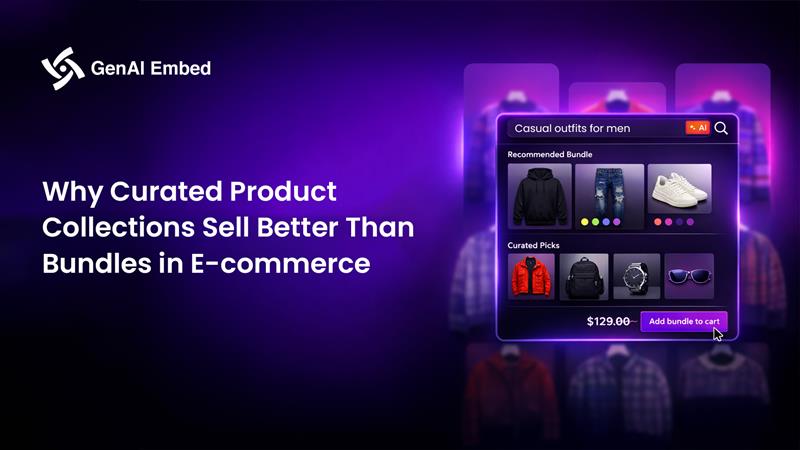
Why Curated Product Collections Sell Better Than Bundles in E-commerce

Product Marketing strategist


If you run an e-commerce store, the question is no longer “Can we bundle products together?”
The better question is this: Are we helping shoppers buy with confidence, context, and momentum?
That is where many bundle strategies begin to fail.
Bundles feel outdated because they are usually static, product-led, and built around retailer convenience. Curated collections sell better because they organize products around a theme, occasion, lifestyle, or need, which makes shopping feel more relevant, more intuitive, and more complete. That difference matters because GenAIEmbed’s Palette is designed to turn traditional bundles into thematic collections that increase average order value, improve engagement, and reduce merchandising effort
A bundle says, “These products go together.”
A collection says, “This is the look, moment, problem, or outcome you are trying to create.”
That second framing is far more powerful in modern retail.
What is the difference between a bundle and a collection?
A bundle is a fixed grouping of products, usually created for convenience, promotion, or cart expansion.
A collection is a curated set of products organized around a story, occasion, customer need, lifestyle, interest, or identity.
That may sound like a branding distinction. It is not. It is a buying-behavior distinction.
Bundles are usually:
static
discount-led
SKU-centric
operational
retailer-defined
Collections are usually:
thematic
context-rich
editorial
shopper-centric
adaptable
GenAIEmbed’s materials describe this shift clearly. Palette transforms traditional product bundling into emotionally engaging, curated collections that foster stronger customer connection and higher transaction value
Bundles vs. collections: side-by-side
Factor | Traditional Bundles | Curated Collections |
|---|---|---|
Core logic | Products grouped together | Products organized around a theme, story, or need |
Shopper experience | Convenient, but often generic | Guided, relevant, and more memorable |
Flexibility | Usually static | Dynamic and easy to refresh |
Emotional pull | Low | Higher because context is built in |
Personalization | Limited | Stronger, especially when based on behavior and interests |
Best use case | Routine add-ons and simple kits | AOV growth, guided discovery, lifestyle merchandising |
Business effect | Can lift basket size | Can lift basket size, engagement, loyalty, and brand recall |
That is the core difference.
Bundles can increase units. Collections can increase value.
Why bundles are losing effectiveness
Bundles are not dead. But they are no longer enough.
1. Bundles reflect catalog logic, not shopper intent
Most bundles are built from inside the business outward.
A merchandiser sees related products and groups them together. The shopper sees a package, but not always a compelling reason.
That is the weakness.
Modern shoppers are not just buying products. They are solving a need, matching a style, preparing for an event, or trying to express an identity. Traditional bundles often miss that layer.
Palette’s positioning is built around this exact gap. Collections are designed to resonate with specific customer needs, interests, and occasions rather than simply grouping related products
2. Bundles are too static for modern retail
Retail changes fast. Inventory changes. Trends change. Seasons change. Shopper language changes.
Static bundles often do not.
Collections are stronger because they can be refreshed based on seasonal demand, current trends, or emerging customer interests. GenAIEmbed positions Palette as a system that supports dynamic collection updates so merchandising stays relevant instead of stale
3. Bundles do not create enough emotional connection
A bundle is useful.
A collection is meaningful.
That difference matters when customers are choosing between brands with similar products and similar pricing. A themed collection creates emotional context and helps shoppers imagine how products fit into their life.
GenAIEmbed’s collection examples show why this works. Narrative-led collection thinking creates stronger shopper resonance than plain product assortments
4. Bundles are weaker at personalization
Bundles tend to be one-size-fits-all.
Collections can be shaped around:
browsing behavior
product interests
style preferences
lifecycle stage
shopping mission
seasonal demand
Palette is designed to tailor collections to customer preferences and browsing history, increasing relevance and purchase likelihood
Why curated collections sell better
This is where the business case gets stronger.
1. Collections increase average order value more naturally
The best cross-sells do not feel like cross-sells.
They feel like completion.
A shopper is far more willing to add products when those products are presented as part of a coherent theme or experience. That is why collections often outperform generic “frequently bought together” logic.
According to GenAIEmbed’s product materials, Palette increased average order value by 15–30% in pilot programs by encouraging multiple related purchases through thematic collections
That is not just a merchandising improvement. It is a revenue improvement.
2. Collections reduce decision fatigue
Large catalogs create friction when shoppers do not know where to start.
Collections reduce that friction by narrowing choices into meaningful sets. Instead of asking a customer to browse hundreds of products, you guide them into a smaller universe built around a clear intent.
That is especially powerful when combined with stronger discovery infrastructure. A shopper might begin with semantic search in e-commerce, move into a curated collection, and convert with less hesitation because the path feels guided, not overwhelming.
3. Collections build stronger brand memory
A discount bundle may improve one order.
A memorable collection can improve the brand itself.
Retailers are not only competing on conversion rate. They are competing on recall, trust, and distinctiveness. A good collection acts like editorial merchandising. It gives the customer a clearer reason to remember you.
GenAIEmbed’s broader platform materials tie Palette to stronger engagement, loyalty, and improved customer lifetime value, not just short-term basket expansion
4. Collections create better cross-sell and upsell conditions
Collections create structure:
hero product
complementary product
premium option
utility item
aspirational add-on
That structure makes cross-sell feel relevant instead of random.
This matters because cross-sell performance improves when the shopper understands the relationship between products. Collections make those relationships visible.
When bundles still make sense
A strong strategy is balanced.
Bundles still work when the buying need is simple, fixed, and operational.
Bundles work well for:
starter kits
replenishment packs
simple accessory add-ons
installation or warranty pairings
product combinations with obvious utility
Examples:
phone + charger + case
razor + replacement blades
desk + cable organizer
mattress + protector
If the buying logic is functional and obvious, a bundle can work perfectly well.
The problem begins when retailers try to use bundles for a job they were never built to do: inspiration, discovery, identity, or guided exploration.
That is where collections win.
What high-converting collections actually look like
A collection is not just a category page with a better headline.
To perform well, it needs structure.
1. A clear narrative anchor
Strong collections are built around:
an occasion
a lifestyle
a problem to solve
a customer identity
a seasonal moment
a visual aesthetic
Examples:
Work-from-home comfort
Minimalist summer wardrobe
Sustainable gifting
Apartment-friendly furniture
Sensitive skin essentials
The tighter the narrative, the stronger the merchandising signal.
2. Product coherence
Products in a collection should feel like they belong together in the shopper’s mind, not just in the inventory system.
That could mean matching:
function
mood
style
use case
material
occasion
3. Personalization
Collections convert better when they reflect real behavior. Palette is built to personalize collections using customer preferences and browsing history, helping move collections from generic inspiration to relevant guidance
4. Dynamic refresh
Collections lose value when they stay unchanged for months. GenAIEmbed positions Palette as adaptable to trends, seasons, and emerging customer interests, which is critical for keeping merchandising fresh
5. Strong discovery paths
Even a great collection fails if shoppers never find it.
Collections should be connected to:
homepage campaigns
search results
product detail pages
navigation hubs
support interactions
post-purchase journeys
[External citation needed: research showing that guided navigation, relevant discovery, or personalized browsing improves shopping efficiency and conversion.]
How AI-powered collections work
This is where many blog posts stop too early.
The real advantage of AI-powered collections is not just faster curation. It is better merchandising logic at scale.
A simple workflow looks like this:
1. Understand the catalog
The system maps product attributes such as style, material, use case, sustainability, and price positioning.
2. Identify shopper intent
It uses behavior, browsing patterns, and business context to understand what kinds of collections are most relevant.
3. Build thematic groupings
Instead of grouping by SKU convenience alone, it creates collections around themes, needs, and occasions.
4. Generate collection narratives
Palette is designed to automate collection narrative creation, reducing manual effort for merchandising and content teams
5. Refresh collections dynamically
Collections can be updated to reflect trend changes, seasonal shifts, and emerging shopper interests
6. Measure commercial impact
The right metrics include:
AOV
units per transaction
collection page conversion rate
assisted revenue
repeat visits
cross-sell attachment rate
Why this matters even more when search is weak
Collections do not replace search. They depend on it.
If shoppers cannot find relevant starting points, they may never reach your best collections. That is why the strongest retail experiences combine:
search that understands intent
collections that guide buying
support that removes hesitation
GenAIEmbed positions the broader problem as a retail experience gap caused by generic search, irrelevant results, and basic bundles, then addresses it through connected search, collection, and support layers
This is where your internal ecosystem matters:
How Palette helps retailers move beyond outdated bundles
Palette is GenAIEmbed’s intelligent collection curator.
Its role is not to create prettier bundles. Its role is to help retailers merchandise around how customers actually buy.
According to GenAIEmbed’s materials, Palette helps retailers:
transform traditional bundles into emotionally engaging thematic collections
personalize collections using browsing behavior and preferences
automate collection narratives and reduce content effort
keep collections current through dynamic updates
increase AOV by 15–30% in pilot programs
reduce merchandising effort by 50% through automation and catalog enrichment support
That makes Palette especially relevant for:
fashion and apparel brands
furniture and home retailers
beauty and cosmetics brands
large-catalog stores that need better guided discovery and stronger cross-sell logic
Explore PalatteAI for the product view, or visit the AI advisory page for a broader strategy discussion.
Final takeaway
Bundles are not obsolete.
They are just too limited to carry modern merchandising on their own.
If the goal is simple convenience, bundles can still work.
If the goal is:
higher AOV
stronger engagement
better guided discovery
more memorable merchandising
stronger brand loyalty
then collections are the better model.
That is the real shift.
Retail is moving from grouping products to shaping buying journeys.
The stores that win will not just show related items. They will create relevant paths.
If your current strategy still depends on static bundles, now is the right time to rethink the model.
Explore PalatteAI, browse the GenAIEmbed blog, or reach out through the contact page to discuss how GenAIEmbed can turn static merchandising into curated, revenue-driving shopping experiences.
[Optional external citation: final high-authority retail trend source reinforcing the move toward personalized, contextual commerce.]
FAQ
Are product bundles outdated in e-commerce?
Not completely. Bundles still work for simple, obvious, utility-based combinations. But they are less effective for discovery-led, style-led, or inspiration-led buying journeys. Curated collections perform better in those scenarios because they provide context and guidance.
Do curated collections convert better than bundles?
They often do when the goal is to increase AOV, support cross-sell, reduce decision fatigue, and create a stronger emotional connection. GenAIEmbed’s Palette is positioned around these outcomes, with pilot programs showing AOV gains of 15–30%
What is the difference between a bundle and a collection?
A bundle is usually a fixed grouping of related items. A collection is a curated set of products built around a theme, occasion, need, or lifestyle story.
How do collections increase average order value?
They increase AOV by making complementary purchases feel more coherent and relevant. Instead of generic add-ons, shoppers see a complete solution, style direction, or buying journey.
When should an online store use bundles instead of collections?
Use bundles when the relationship between products is simple, functional, and obvious. Use collections when the goal is inspiration, guidance, identity-based shopping, or editorial merchandising.
Can AI create product collections automatically?
Yes. AI can help analyze the catalog, identify themes, personalize groupings, generate collection narratives, and refresh collections as trends or shopper behavior changes. That is a core part of what Palette is built to do