
How to Increase Customer Lifetime Value in Ecommerce

Product Marketing strategist


Your traffic numbers look healthy. Your conversion rate is holding steady. But your revenue is not growing the way it should.
Before you increase your ad budget or chase more traffic, look at a simpler number first.
Average order value, or AOV, is the average amount each customer spends per transaction. It is calculated by dividing your total revenue by your total number of orders. And it is one of the most controllable revenue levers available to any ecommerce brand, because increasing it requires no additional customers and no additional ad spend.
Consider this: if your store processes 1,000 orders per month at an average of $50 each, your monthly revenue is $50,000. Increase that average to $75 through smarter merchandising, and you generate $75,000 from the same traffic. That is a 50% revenue increase without acquiring a single new customer, according to Growth Engines' 2026 AOV optimization research.
This guide covers the ten strategies with the strongest documented impact on average order value in 2026, the data behind each one, and how AI-powered discovery and personalization are transforming what AOV optimization looks like for retail brands at scale.
Why Increasing AOV Is the Smartest Revenue Strategy Right Now
Customer acquisition costs have risen more than 222% over the last decade. For many ecommerce brands, the economics of growth through new customer acquisition alone have become unsustainable. Digital ad prices are outpacing revenue growth. Market saturation is increasing. And every new customer you win comes with a cost that eats into your margin.
Increasing AOV solves a different problem. You are working with customers who have already chosen to visit your store. They are already engaged. The psychological and logistical cost of getting them to add one more relevant item to their cart is dramatically lower than the cost of acquiring a new shopper from scratch.
AOV is rising 8.7% year over year across all ecommerce verticals, according to Kard's ecommerce growth research. But brands actively optimizing their AOV are capturing that growth at a far higher rate than those who are not. Companies implementing comprehensive AOV optimization strategies are seeing 15 to 30% increases, and those using AI-powered personalization alongside strategic bundling are consistently hitting the upper end of that range, according to Envive AI's 2026 AOV statistics.
The most important thing to understand about AOV is that it is a downstream result. It reflects the quality of your discovery experience, the relevance of your product recommendations, and the confidence your shoppers feel when making decisions. Fix those upstream elements and AOV improves naturally.
What Is a Good Average Order Value for Ecommerce in 2026?
Before optimizing, you need to know what you are optimizing toward. AOV benchmarks vary significantly by category.
The worldwide average order value sits at approximately $116, according to ECDB data cited by Envive AI. However, category averages diverge sharply:
Luxury and jewelry leads at $436 per order
Home and furniture averages $253, driven by coordinated room-package selling
Fashion and apparel sits at $191 to $196, driven by outfit recommendations and seasonal collections
Beauty and personal care averages $71, with significant upside through subscription and bundle strategies
Top 10% of Shopify stores maintain AOV above $326, nearly four times the platform average of $78 to $92
The practical takeaway is to benchmark your AOV against your specific category, not the global average. A fashion brand at $150 AOV may be underperforming while a beauty brand at $90 may be well above category average.
10 Proven Strategies to Increase Average Order Value in Ecommerce
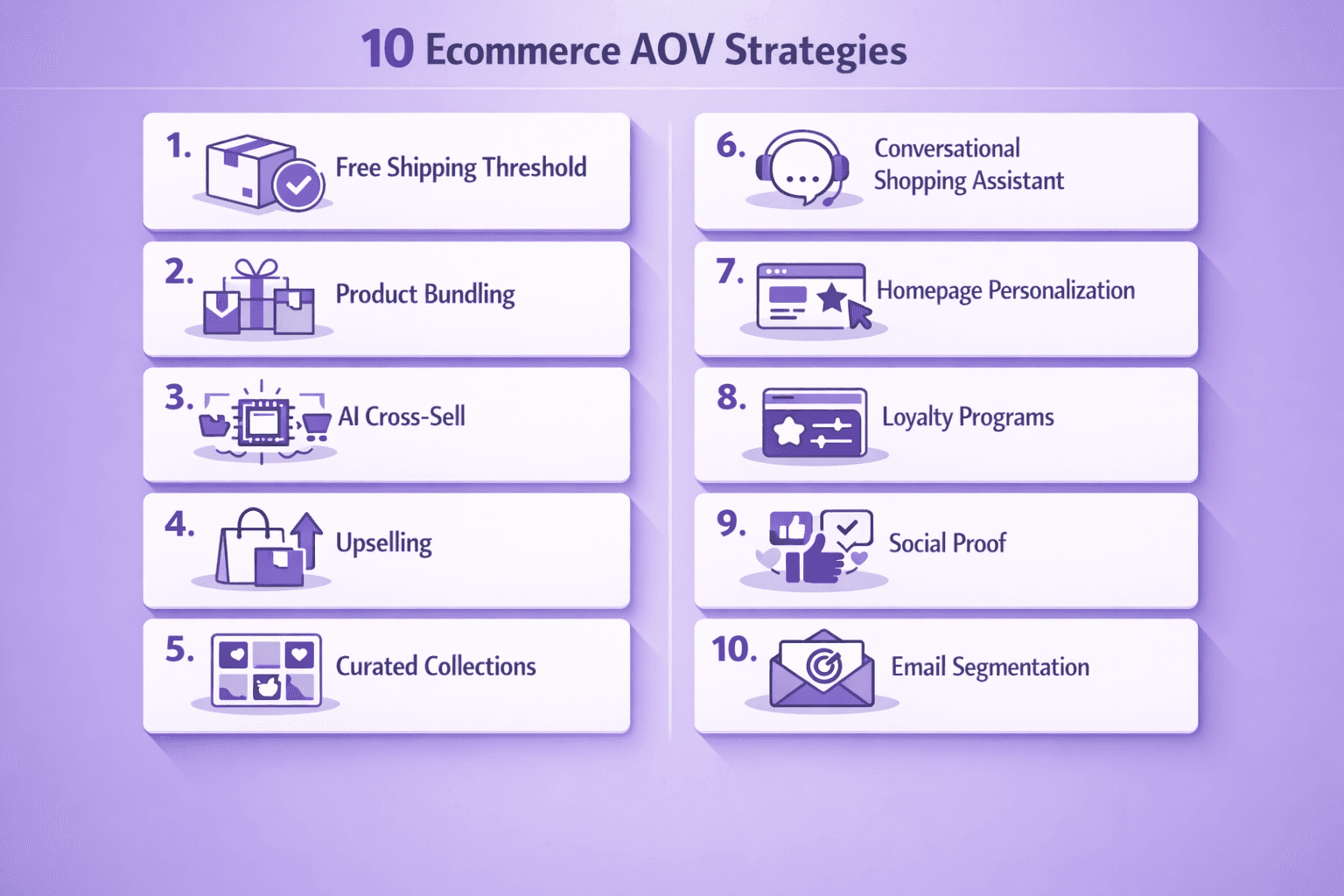
1. Set a Free Shipping Threshold Just Above Your Current AOV
Free shipping thresholds are one of the most reliable and immediately actionable AOV drivers in ecommerce. Approximately 80% of shoppers are willing to add items to their cart to qualify for free shipping, and around 58% actively do so, according to Envive AI's AOV research.
The key to making this work is threshold placement. Set it at 10 to 30% above your current average order value so the gap feels achievable rather than discouraging. A shopper with $65 in their cart who sees "Add $15 more for free shipping" will almost always look for something to add. A shopper with $65 who sees "Add $80 more for free shipping" will often abandon instead.
Display the progress toward the threshold early and prominently. Show it on the product page, the mini-cart, and the full cart view, not just at checkout. Visibility at the browsing stage gives the shopper time to explore additional products with the threshold in mind.
2. Use Product Bundling Strategically, Not Just Conveniently
Product bundling is one of the highest-impact AOV strategies available, and most ecommerce brands are still using it as a discount tactic rather than a discovery and value-creation tool.
When done correctly, bundling simplifies the shopper's decision, increases perceived value, and moves the basket from a single-item purchase to a multi-item solution. Brands implementing well-designed bundle strategies see 20 to 30% AOV improvements, with best-in-class implementations reaching 40%, according to Swell's 2026 product bundling research. McKinsey research confirms that strategic bundling boosts sales by 20% while simultaneously increasing profits by 30%.
The difference between bundles that work and bundles that do not is context. A bundle that groups items because they are frequently bought together is useful. A bundle that groups items because they serve a shared occasion, use case, or lifestyle tells a story and gives the shopper a reason to buy the complete set rather than picking individual pieces.
Understanding the difference between curated product collections and simple bundles is critical here. A collection called "Weekend Getaway Edit" that bundles items around a specific occasion converts at a fundamentally different rate than a generic "frequently bought together" widget, because the collection creates aspiration and the widget creates convenience. Both have value, but only one grows the basket through discovery.
3. Deploy AI-Powered Cross-Sell Recommendations at Every Stage
Cross-selling is responsible for 35% of Amazon's total revenue. It outperforms upselling by a factor of 20 in ecommerce contexts, according to Kard's AOV research. And the brands doing it most effectively are doing it with AI, not manual merchandising rules.
AI-powered cross-sell recommendations analyze purchase behavior, real-time browse signals, and product relationships to surface the most relevant complementary items for each individual shopper at the moment they are most likely to add them. Sessions where shoppers engage with AI-powered recommendations show a 369% increase in average order value, according to Envive AI's personalization statistics.
For retail brands in fashion, beauty, lifestyle, and home decor, the most effective cross-sell placement is on the product detail page, in the cart, and in post-purchase flows. A shopper who has just decided to buy one item is primed to discover what completes the picture. The recommendations you show in that moment define whether they leave with one item or three.
This is exactly what AI-powered product discovery is built to do. Rather than showing generic "customers also bought" lists, a genuine AI discovery layer understands the context of what the shopper is looking at and surfaces items that fit the same occasion, aesthetic, or use case.
4. Use Upselling to Move Shoppers to Higher-Value Versions
While cross-selling adds more items to the basket, upselling moves the shopper to a higher-value version of what they are already considering. Both matter for AOV, and both require relevance and timing to work.
Upselling works best when the premium version offers a clear, specific advantage that the shopper can immediately understand. Not "this one is better" but "this set includes the full collection and saves you 20% compared to buying them individually." The value proposition needs to be visible, concrete, and easy to evaluate.
AI-powered upsell recommendations that understand customer intent and budget achieve significantly higher conversion rates than generic approaches, according to Alhena AI's upsell research. Tatcha, the luxury skincare brand, achieved a 38% AOV uplift using contextual AI upsell recommendations that matched shopper intent and purchase history rather than applying generic upgrade prompts.
Order bumps, which present a single relevant add-on at the cart or checkout stage, achieve the highest upsell conversion at 37.8%, according to Envive AI's upsell statistics. The key is that the bump must be contextually relevant, low friction, and clearly complementary to what is already in the cart.
5. Build Curated Collections That Create Multi-Item Discovery Journeys
One of the most underutilized AOV drivers in ecommerce is the quality of the discovery journey itself. Most stores show products in isolation. A shopper finds one item, views it, and buys it or does not. The experience provides no natural bridge to discovering a second, third, or fourth item.
Curated collections change this dynamic entirely. When products are grouped around a theme, occasion, lifestyle, or aesthetic, the shopper enters a context that naturally encourages multi-item exploration. "Office-Ready Summer Edit" creates a discovery environment where three to six complementary items all make sense together. The shopper's basket builds not because they were pushed to add more but because the experience made the additional items feel obviously relevant.
The guided discovery approach to ecommerce product collections is one of the highest-ROI investments a retail brand can make for AOV, because it builds basket size through inspiration rather than through discount incentives or aggressive upsell prompts. It grows the basket without eroding the margin.
This is the foundation of how PaletteAI's Curated Collection Engine works. Instead of showing shoppers a grid of products organized by category, PaletteAI builds story-driven collections organized around occasion, lifestyle, season, and shopper intent. A shopper who arrives looking for one thing discovers a complete set of items that fit their context, and the basket naturally builds from there.
6. Use a Conversational Shopping Assistant to Guide the Undecided Shopper
Many shoppers who have the intent and the budget to buy more leave with less because they could not figure out what else to add. They want guidance but do not know how to ask for it in a search bar. They are open to suggestions but do not trust generic "you may also like" widgets.
This is where conversational AI shopping assistants create a direct, measurable impact on AOV. Customers engaging with AI chat features show 25% higher AOV than those who do not use conversational tools, according to Envive AI's AOV research. The personalized guidance and contextual product suggestions during a real conversation naturally drive larger basket sizes.
Think of it from the shopper's perspective. Rather than browsing silently and hoping to discover the right combination, they can ask:
"What would go well with this jacket for a casual weekend look?"
"I want to build a complete skincare routine under a specific budget. Where do I start?"
"Show me everything I would need for a beach holiday."
"Help me find a gift set for someone who loves cooking."
Each of these questions opens a discovery journey that a search bar simply cannot facilitate. The answer to each one is naturally a multi-item recommendation. That is how a conversational assistant turns a $45 single-item purchase into a $130 basket without the shopper feeling pressured or over-sold.
PaletteAI's Styling Assistant is built for exactly this moment. It engages shoppers in real-time conversation, understands their occasion, preference, and context, and guides them toward a complete, confident purchase. The result is a shopper who buys more, spends more, and feels better about their decision because they received genuine guidance rather than a generic upsell prompt.
7. Personalize Your Homepage and Collection Pages to Match Shopper Intent
A shopper who sees a homepage that reflects their interests and past behavior is far more likely to explore multiple products than a shopper who sees a generic front page. This sounds obvious but most ecommerce stores still serve the same homepage to every visitor.
AI-powered retail personalization changes the discovery experience from the very first moment a shopper lands on your site. A returning customer who browsed summer dresses last week should see a summer collection on their next visit, not a generic "New Arrivals" page. A first-time visitor who arrived from a TikTok video about minimalist home decor should see a collection that matches that context.
When the first thing a shopper sees is personally relevant to them, they explore more deeply. They discover more products. They build a basket that reflects genuine interest rather than accidental browsing. That deeper exploration is what lifts AOV.
Companies using AI-driven personalization earn 40% more revenue than those without it, according to research cited by InsiderOne's 2026 AI retail trends report. The AOV impact is a direct function of how well your discovery experience serves each individual shopper from the first page they land on.
8. Activate Loyalty Programs That Reward Basket-Building Behavior
Loyalty programs have a well-documented AOV impact. Repeat customers spend 67% more than first-time buyers, and loyalty members show 40% higher AOV compared to non-members, according to Envive AI's AOV research.
The reason is straightforward. Loyalty members have a stronger relationship with your brand. They trust your quality. They are familiar with your catalog. And when you give them a reason to build a larger basket, through tiered rewards, progress toward a redemption threshold, or exclusive access to collections, they are more likely to act on it.
The most effective loyalty structures for AOV tie rewards to specific behaviors you want to encourage. Rather than simply rewarding total spend, reward combination purchases, collection exploration, and full-outfit or full-routine completions. A shopper who earns double points for purchasing from a curated collection rather than individual items is a shopper who builds the basket you want to see.
Building post-purchase journeys that drive retention also feeds AOV through repeat purchase behavior. A shopper who receives a relevant, personalized follow-up recommendation after their first purchase is far more likely to return for a second order, and their second order tends to be larger than their first because their confidence in your brand has grown.
9. Surface Social Proof at the Basket-Building Stage
Social proof is most often used at the product level to convert hesitant shoppers. Its impact on AOV is less discussed but equally significant.
Shoppers will spend 31% more with online businesses that have strong, visible reviews, according to Paddle's AOV research. When a shopper sees that the complementary item you are recommending has 400 five-star reviews, their resistance to adding it drops. When they see that other customers who bought the item they are considering also bought three additional products and loved the combination, the case for building a larger basket becomes emotionally compelling.
The strategic placement of social proof matters. Show review scores near your cross-sell recommendations, not just on individual product pages. Display "most popular bundle" labels on collection pages. Surface real-time purchase activity to show that other shoppers are building similar baskets. These signals reduce the psychological friction of adding items and increase the shopper's confidence that they are making good choices.
10. Segment Your Email Campaigns Around Basket-Building Opportunities
Email is one of the most direct channels available for AOV improvement, particularly in post-purchase and re-engagement flows where the shopper already has context from a previous order.
Segmented and personalized email campaigns generate 6 times higher transaction rates and AOV than non-personalized emails, according to data referenced in Envive AI's ecommerce personalization statistics. AI-personalized upsell emails specifically lift AOV by nearly 28%, according to Alhena AI's research.
The most effective email frameworks for AOV include:
Post-purchase follow-ups that recommend complementary items to what was just bought, sent within 24 to 48 hours while the purchase is fresh
Collection launch campaigns that show the full story behind a curated set, giving shoppers who previously bought one item a reason to complete the look
Threshold-based nudge emails that show a shopper how close they are to a loyalty reward or free shipping qualification, with specific product suggestions to bridge the gap
Seasonal and occasion-based collection emails that match an upcoming occasion to a complete set of relevant items
The key across all of these is personalization at the segment level at minimum, and at the individual level wherever your data infrastructure allows. A generic "check out our new arrivals" email will not move AOV. A "here is what pairs perfectly with the boots you bought last month" email will.
How PaletteAI Increases Average Order Value Across Every Stage of the Shopping Journey
Most AOV optimization tools address one stage of the funnel. They fix the cart page or they improve the checkout flow or they add a recommendation widget. Each of these creates a marginal lift.
PaletteAI takes a different approach. It addresses AOV at the discovery layer, where basket size is actually determined long before a shopper reaches checkout.
The insight behind PaletteAI is straightforward. Shoppers do not build large baskets because they were pushed to at checkout. They build large baskets because they discovered multiple items that genuinely fit their need, occasion, or taste during the exploration stage. When discovery is well-organized, personally relevant, and contextually rich, multi-item purchases happen naturally.
PaletteAI's five core capabilities each contribute to AOV in a distinct way.
The Curated Collection Engine organizes products into story-driven collections built around occasion, lifestyle, season, and shopper intent. Instead of showing a shopper one product in isolation, it shows them a complete idea. "Cozy Winter Edit" or "Travel Light Picks" creates a context where five items feel like a cohesive purchase rather than five separate decisions. The shopper's basket builds because the collection makes sense as a whole.
The Personalized Discovery Layer ensures that each shopper sees the collections most relevant to their behavior and context. A shopper who has been browsing formal workwear sees the office collection. A shopper who arrived from a travel inspiration post sees the travel collection. Relevance at the discovery stage is the single most powerful driver of deeper exploration and higher basket value. You can explore how this connects to a broader ecommerce personalization strategy that extends across every channel your brand operates.
The AI Recommendation Engine surfaces related, complementary, and contextually relevant products at every stage of the journey. Unlike generic recommendation widgets, PaletteAI's recommendations are grounded in collection context. They reinforce the story the shopper is in, making each additional item feel like a natural addition rather than a random suggestion.
The Styling Assistant is PaletteAI's conversational shopping guide. It is the component that converts the undecided shopper into a confident multi-item buyer. By engaging in real conversation about occasion, preference, and context, it guides shoppers to complete their purchase with confidence, and confident shoppers consistently build larger baskets than uncertain ones. The data on this is clear: customers using AI-assisted chat show 25% higher AOV than those who shop without guidance.
The Omnichannel Collection Activation layer extends the same discovery experience across your website, mobile app, email, in-store, and social commerce touchpoints. When a shopper who discovered a collection on Instagram lands on your website, the same collection context should greet them rather than a generic homepage. Continuity of the discovery experience across channels is what turns a single channel engagement into a multi-item purchase.
Together, these five capabilities address AOV not as a checkout problem but as a discovery problem. When the shopping experience makes it easy, relevant, and natural for a shopper to build a complete basket, they do exactly that.
How to Measure and Track Your AOV Improvements
Increasing AOV without a measurement framework is guesswork. Here is how to track it accurately and identify where your biggest opportunities are.
Your baseline AOV formula: Total Revenue divided by Total Number of Orders for a given time period.
Track it consistently. Weekly reports let you spot the impact of specific campaigns, collection launches, and page changes faster than monthly tracking does.
Beyond the overall number, segment your AOV by:
Traffic source: Paid social, organic search, direct, and email buyers behave differently. Understanding which sources drive your highest AOV tells you where to invest.
Customer segment: First-time buyers versus repeat customers. Loyalty members versus non-members. High-AOV segments reveal which behaviors you want to encourage.
Product category: Which categories naturally drive multi-item purchases and which tend toward single-item transactions?
Channel entry point: Shoppers who discover you through a curated collection typically show higher AOV than shoppers who arrive through a product-specific search. This difference quantifies the value of collection-led discovery.
The most important thing to watch is the relationship between AOV and conversion rate. They often move in opposite directions. A very high free shipping threshold may raise the AOV of completed orders but suppress your overall conversion rate by discouraging shoppers who cannot reach the threshold. The goal is not the highest possible AOV in isolation. It is the highest possible revenue per visitor, which balances AOV and conversion together.
Frequently Asked Questions
Q: What is average order value and why does it matter for ecommerce? Average order value is the average amount each customer spends per transaction, calculated by dividing total revenue by total number of orders. It matters because increasing it generates more revenue from your existing traffic without requiring additional ad spend or customer acquisition. A 20% increase in AOV on the same traffic volume produces a 20% increase in revenue, making it one of the most cost-effective growth levers available to ecommerce brands.
Q: What is a good average order value for ecommerce in 2026? The global average sits at approximately $116 across all ecommerce categories, but this number varies dramatically by vertical. Luxury and jewelry averages $436, home and furniture averages $253, fashion averages $191 to $196, and beauty sits at $71. The most useful benchmark is your specific category average, not the global figure. Top 10% Shopify merchants maintain AOV above $326 through advanced personalization, strategic bundling, and premium positioning.
Q: What is the fastest way to increase average order value? Setting a free shipping threshold 10 to 30% above your current AOV is typically the fastest driver because it requires no technical changes and produces immediate behavior changes in shoppers already in the purchase funnel. Combined with clear threshold visibility across the cart and product pages, this single change can produce measurable AOV lift within days. For longer-term structural improvement, AI-powered personalization and curated collection experiences consistently deliver the highest sustained AOV gains.
Q: How does product bundling increase average order value? Bundling increases AOV by reducing decision complexity and increasing perceived value. When products are grouped around a shared use case, occasion, or outcome, shoppers see the complete picture rather than individual items. McKinsey research confirms that strategic bundling boosts sales by 20% and profits by 30%. The most effective bundles are those that tell a story and serve a clear purpose, such as a complete skincare routine or a full outfit for a specific occasion, rather than generic groupings of popular items.
Q: How does AI personalization increase average order value? AI personalization increases AOV by surfacing contextually relevant products at each stage of the discovery journey, making multi-item purchases feel natural rather than forced. Sessions where shoppers engage with AI-powered recommendations show 369% higher AOV than non-personalized sessions, according to Barilliance data cited by Envive AI. Companies implementing AI-driven personalization consistently report 15 to 30% AOV improvements, with real-time personalization delivering 20% higher results than batch-processing approaches.
Q: What role does a conversational shopping assistant play in AOV? A conversational shopping assistant guides undecided shoppers toward multi-item purchases by understanding their specific occasion, preference, and context and making relevant, complete recommendations in response. Customers who engage with AI chat features show 25% higher AOV than those who shop without guidance. The assistant converts what would have been a single-item purchase into a guided discovery journey that ends with a shopper who has found everything they need for a specific occasion, context, or use case.
Conclusion
Increasing average order value is one of the highest-return strategies available to any ecommerce brand in 2026 because it grows revenue from the traffic you already have, without increasing acquisition costs.
The brands seeing the strongest results are not chasing AOV through aggressive checkout prompts or discount-driven bundling. They are building discovery experiences that make multi-item purchases feel natural, relevant, and genuinely valuable. They are using AI-powered recommendations to surface the right products at the right moment. They are building curated collections that give shoppers a complete idea to explore rather than an isolated product to evaluate. And they are deploying conversational tools that guide uncertain shoppers to confident, basket-filling decisions.
Every one of these strategies works individually. Together, they compound. A shopper who arrives through a personalized collection, explores related items through an AI recommendation engine, gets guidance from a conversational assistant, and completes a purchase above a free shipping threshold will consistently spend two to three times more than a shopper navigating a generic grid with no support.
That is what PaletteAI is built to deliver.
Request a Product Discovery Audit and see how AI-powered discovery, curated collections, and conversational guidance can transform your average order value without increasing your ad spend.
Sources and Citations
Shopify: Average Order Value: Formula, Benchmarks and 7 Ways to Increase It 2026
Envive AI: 39 Average Order Value Boost Statistics 2026
Envive AI: 63 AI Personalization in Ecommerce Lift Statistics 2026
Envive AI: 26 AI-Powered Upsell Statistics in Ecommerce
Kard: 10 Proven Ways to Increase Average Order Value for Ecommerce Growth
Swell: 33 Physical Product Bundling Statistics Every Ecommerce Brand Needs in 2026
Alhena AI: AI Product Recommendations for Upselling and Cross-Selling
Growth Engines: How to Increase Average Order Value: Complete Guide for Ecommerce
Triple Whale: How to Increase Average Order Value: 17 Strategies That Actually Drive Profitable Growth
InsiderOne: AI in Retail: 10 Trends Shaping Ecommerce in 2026
Redtrack: How to Increase Average Order Value: Proven Strategies for 2026