
Social Commerce Strategy 2026: How Retail Brands Win on TikTok, Instagram, and Beyond

Product Marketing strategist


Introduction
Social commerce strategy has moved from an optional experiment to a primary revenue channel for retail brands in 2026.
US social commerce has crossed $100 billion for the first time this year, growing 18% year over year according to EMARKETER. Globally, the market has already passed $2 trillion and is on track to hit $8.5 trillion by 2030.
More importantly, over 60% of product discovery now happens on TikTok, Instagram, and YouTube. Shoppers are not waiting to visit your website. They are finding products, evaluating them, and buying them without ever leaving the social platform they were already on.
This guide covers the complete social commerce strategy playbook for retail brands in 2026: which platforms deserve your investment, how to build content that converts, how to run live shopping events, and how AI-powered product discovery connects your social presence to your wider customer experience.
By the end you will know exactly where to start, what the data says actually works, and how to build a social commerce operation that drives measurable revenue.
What Is Social Commerce and Why Does It Matter for Retailers in 2026?
Social commerce is the practice of selling products directly through social media platforms, where product discovery, consideration, and purchase all happen inside a single app without the shopper ever needing to visit an external website.
This is not the same as social media marketing. Traditional social media advertising drives traffic to your website. Social commerce eliminates that redirect entirely. The customer sees a product in a TikTok video, taps to view it, and completes the purchase inside TikTok Shop without leaving the app.
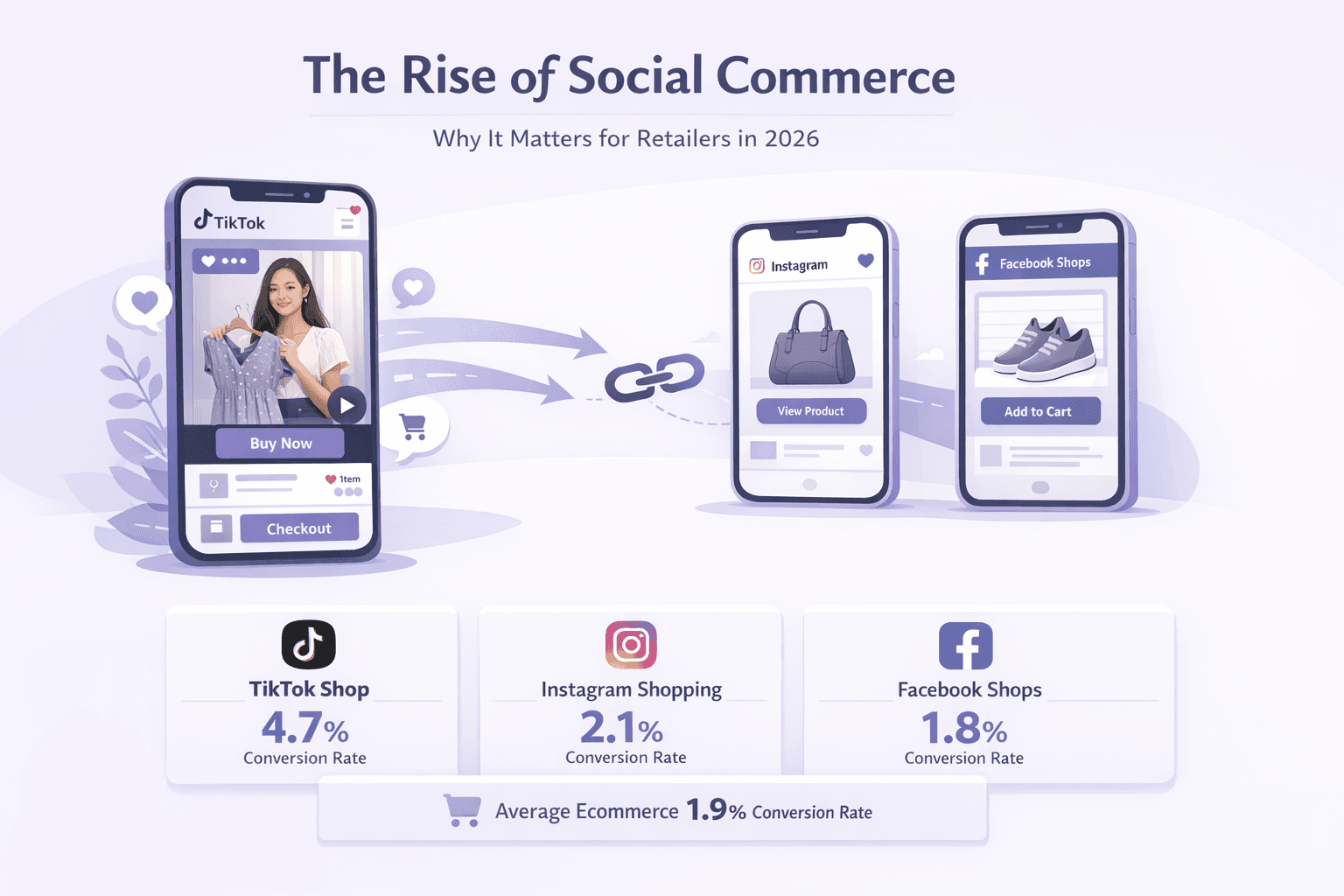
That removal of friction is why social commerce conversion rates are outperforming traditional ecommerce in several verticals. TikTok Shop converts at 4.7%, more than double Instagram Shopping at 2.1% and nearly triple Facebook Shops at 1.8%, according to data from Short Form Nation's 2026 platform analysis.
For context, the global average ecommerce conversion rate is 1.9%. TikTok Shop's native conversion rate is already 2.5 times higher than the average standalone ecommerce store.
The Scale of the Shift Is Happening Right Now
The numbers behind social commerce in 2026 are not projections. They are current reality.
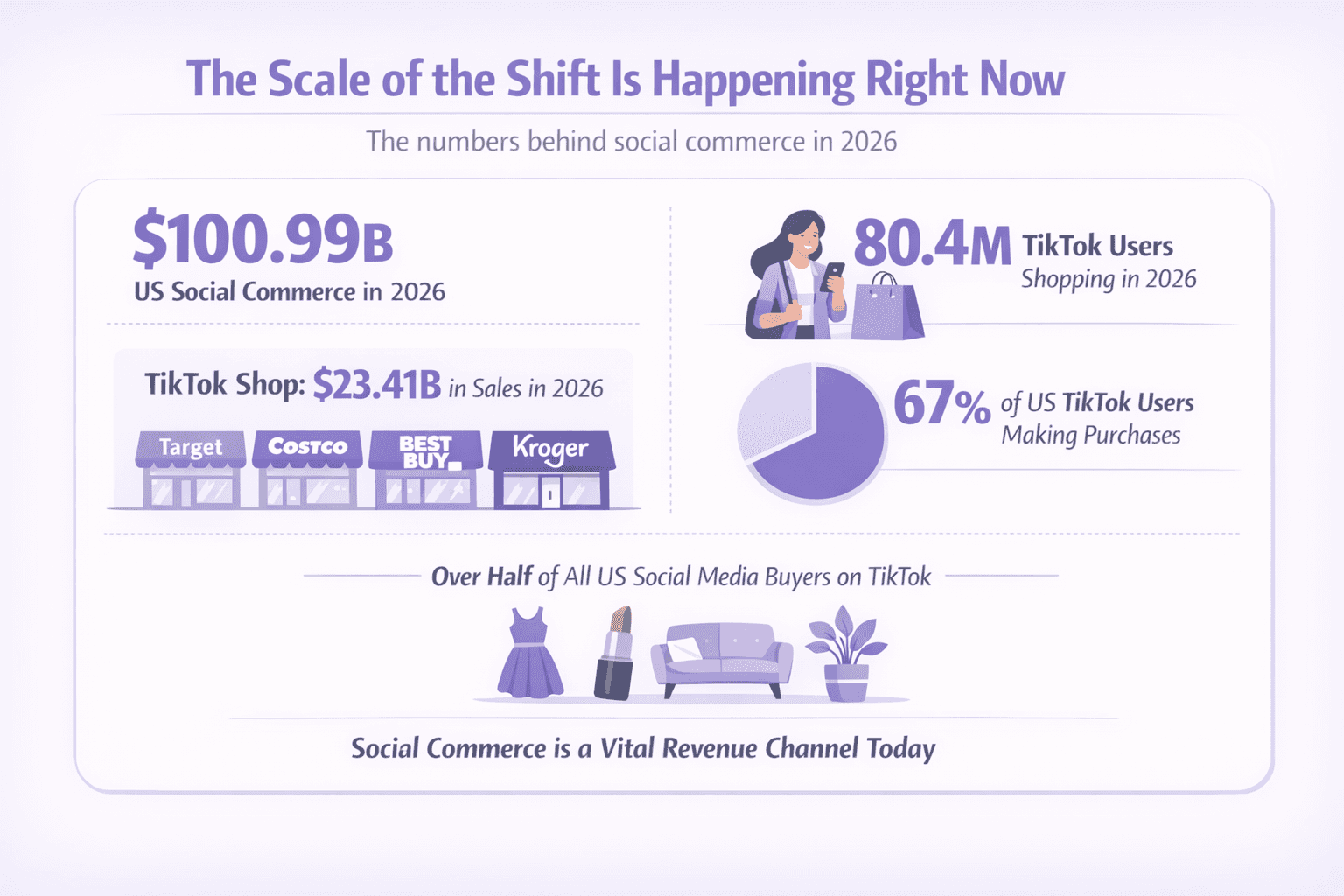
US social commerce has surpassed $100.99 billion in 2026, representing 7.2% of all US ecommerce sales
TikTok Shop alone is projected to generate $23.41 billion in US ecommerce sales in 2026, a 48% year-over-year increase
That figure is larger than the US ecommerce businesses of Target, Costco, Best Buy, and Kroger
80.4 million US users are expected to shop on TikTok in 2026, representing 67% of TikTok's US audience
Over half of all US social media buyers will make a purchase on TikTok this year, according to EMARKETER's US Social Commerce Forecast
For any retail brand selling in categories like fashion, beauty, accessories, lifestyle, or home decor, social commerce is no longer a future consideration. It is an active revenue channel requiring a dedicated strategy today.
Social Commerce Platform Strategy: Where to Focus Your Investment
Not all platforms deliver equal results. Your social commerce strategy should be built around where your specific audience is already shopping, not around where the most coverage exists.
Here is a clear breakdown of each major platform's strengths in 2026.
TikTok Shop: The Highest-Converting Social Commerce Platform
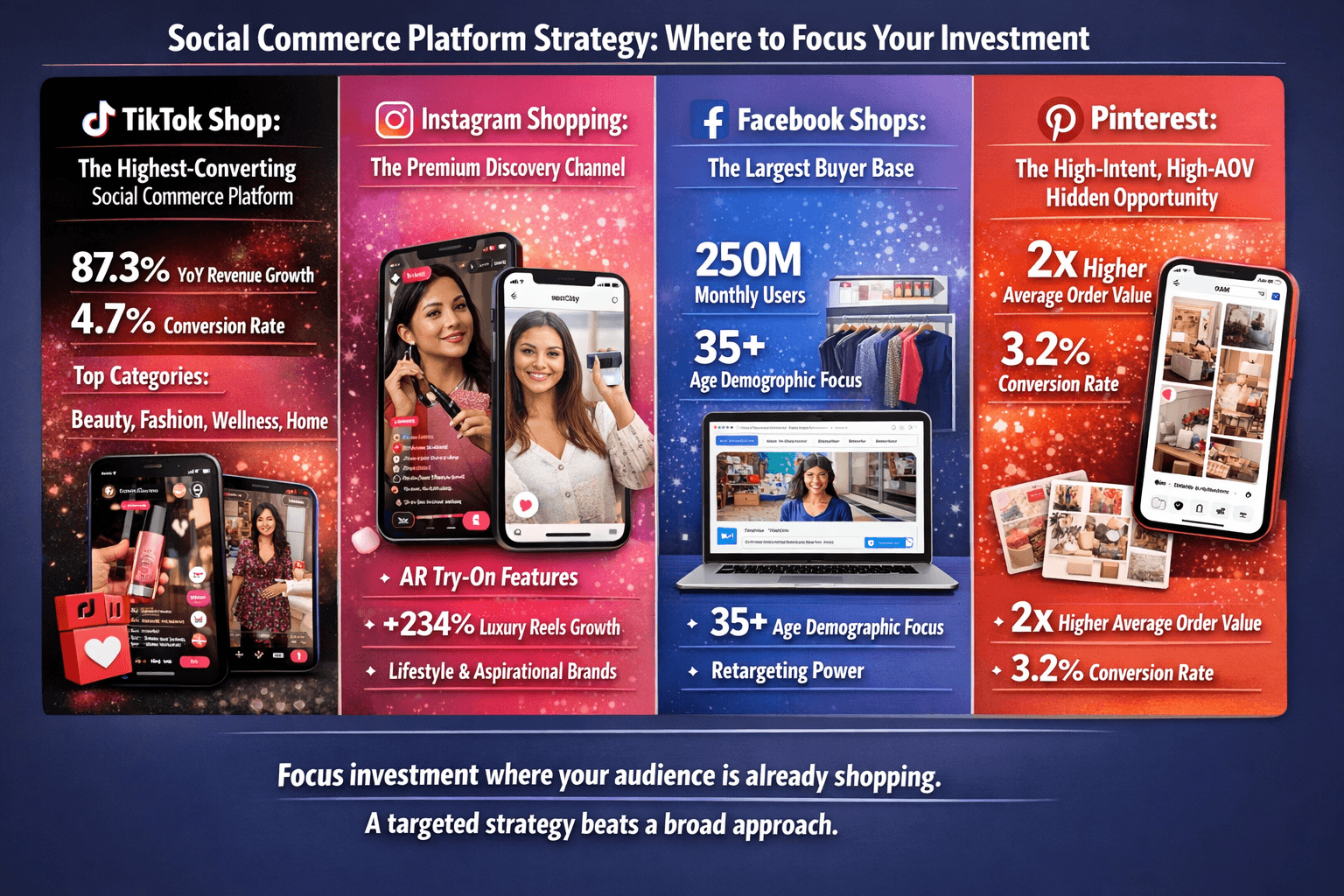
TikTok Shop is the defining social commerce story of 2026. Its 87.3% year-over-year revenue growth and 4.7% conversion rate make it the highest-performing social commerce platform by both metrics.
TikTok's algorithm functions as a product discovery engine at scale. It surfaces products through creator videos and live shopping streams to users who match the product's target profile, even if those users have never searched for the product or followed the brand.
The categories seeing the strongest results on TikTok Shop are health and wellness, beauty, accessories, fashion, and household items. During Black Friday and Cyber Monday 2025, TikTok Shop generated over $500 million in sales across four days, with 760,000 livestream sessions drawing 1.6 billion views, according to 1440.io's 2026 retail report.
What works on TikTok Shop:
Short-form creator content showing products in real, authentic contexts
Live shopping events with time-limited offers and product demonstrations
Creator affiliate partnerships with performance-based compensation
GMV Max, TikTok's unified AI-optimized shopping ad system launched July 2025
Instagram Shopping: The Premium Discovery Channel
Instagram remains the most important social commerce platform for brand positioning and product aspiration. Its strength is visual storytelling that connects products to lifestyle and identity.
Instagram Shopping allows brands to tag products directly in posts, Stories, and Reels, creating a seamless path from inspiration to purchase. Meta introduced AR try-on features on Instagram Shopping in early 2025, which reportedly lifted conversion rates by around 30% for participating brands, according to 1440.io.
Reels video views for luxury brands grew 234% in Q2 2025, according to EMARKETER Industry KPIs. For fashion, beauty, and premium lifestyle brands, Instagram is where brand equity and social commerce combine most effectively.
What works on Instagram Shopping:
Product tagging in Reels with editorial-quality creative
Story-driven collections that match product to occasion or lifestyle
Creator partnerships with strong visual aesthetics aligned to your brand
DM-based commerce for personalized recommendations at scale
Facebook Shops: The Largest Buyer Base
Facebook Marketplace and Facebook Shops still command the largest social commerce buyer base in the US, with 250 million monthly Facebook Shops users.
However, Facebook's social commerce growth rate has slowed to 4.2% year over year, compared to TikTok Shop's 87.3%. Facebook's strength today is reach and retargeting, particularly for audiences aged 35 and above, where TikTok's penetration is lower.
For brands selling to multiple generations, Facebook Shops provides valuable incremental coverage and a reliable retargeting environment through Meta's advertising infrastructure.
Pinterest: The High-Intent, High-AOV Hidden Opportunity
Pinterest does not generate the headlines that TikTok Shop does, but its commercial fundamentals are exceptional.
Pinterest shoppers spend 2 times more per month than shoppers on other platforms. 93% of Pinterest users actively use the platform to plan purchases. Pinterest's conversion rate of 3.2% exceeds Instagram Shopping's 2.1% and sits close to TikTok Shop's 4.7%, according to Ringly.io's 2026 social commerce analysis.
For fashion, beauty, home decor, and gifting brands, Pinterest represents a high-intent audience that is actively planning purchases rather than impulse-browsing. It deserves a dedicated presence in any serious social commerce strategy.
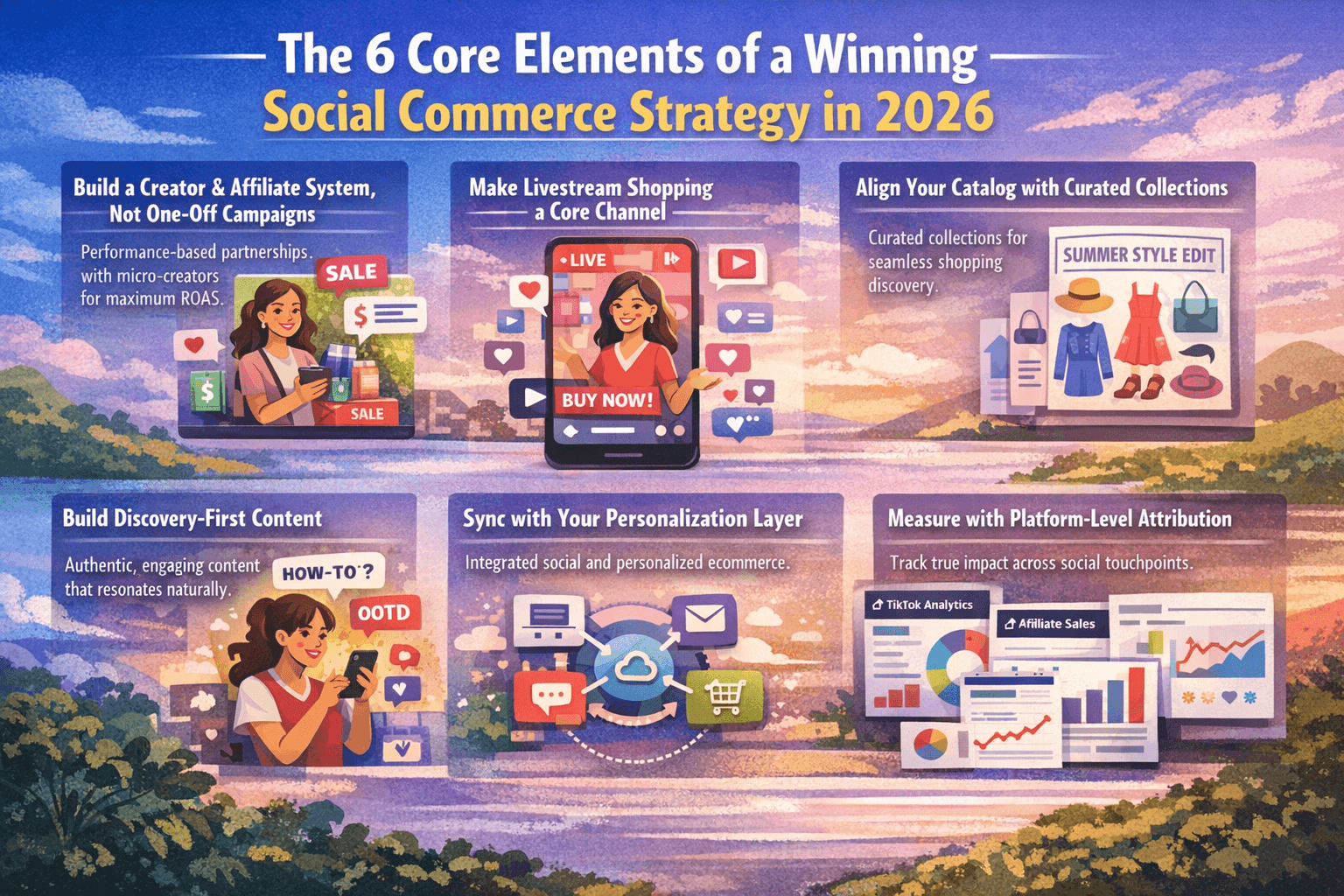
The 6 Core Elements of a Winning Social Commerce Strategy in 2026
Understanding which platforms to use is only the beginning. The brands generating disproportionate revenue from social commerce are operating with a structured playbook. Here are the six elements that separate top performers from the rest.
1. Build a Creator and Affiliate System, Not One-Off Campaigns
Creator content drives social commerce more effectively than brand-produced content across every major platform. The reason is simple. Shoppers trust other people more than they trust brand marketing.
Customer reviews and creator content influence 62% of shoppers in social commerce purchase decisions, according to SellersCommerce's research. Influencer-driven product discovery is one of the primary reasons the social commerce category is growing faster than traditional ecommerce.
However, the approach that works in 2026 is performance-based creator partnerships, not flat-fee sponsorships. Brands that tie creator compensation to actual sales, using TikTok Shop's affiliate program, Instagram's collaboration tools, or dedicated affiliate platforms, see 4 to 8 times ROAS compared to flat-fee models, according to ECOSIRE's 2026 social commerce analysis.
Build a roster of 10 to 30 micro-creators with genuine audiences in your category. Give them product, a brief, and a performance incentive. Let them create in their own voice. That authenticity is what drives conversion.
2. Make Livestream Shopping a Core Channel, Not an Experiment
Live shopping converts at up to 30%, compared to the 2% to 3% average for traditional ecommerce. Global livestream sales are projected to exceed $1 trillion in 2026, according to Mordor Intelligence data cited by Ringly.io.
Two in three global shoppers have expressed interest in live shopping, yet most Western retail brands still treat it as a novelty rather than a revenue channel. This gap represents one of the clearest available opportunities in social commerce.
Effective live shopping events combine several conversion drivers simultaneously. Real-time social proof from other viewers purchasing creates urgency. Product demonstrations answer the questions that static images cannot. Limited-time offers create genuine scarcity rather than manufactured countdown timers. Host rapport builds the trust that cold advertising cannot replicate.
For fashion, beauty, and lifestyle brands, a weekly or biweekly live shopping session with a consistent host and an AI-powered curated collection creates a community dynamic that compounds in value over time. Viewers return as regulars. Regulars become advocates.
3. Align Your Social Commerce Catalog With Curated Collections
This is where most brands leave significant social commerce revenue uncaptured.
Social platforms are discovery environments. Shoppers are not arriving on TikTok with a specific product in mind. They are browsing, being entertained, and responding to inspiration. A single product link in a creator video captures the shoppers who decide immediately. A curated collection captures the shoppers who need to explore.
When your TikTok Shop or Instagram Shopping catalog is organized into curated collections built around occasion, lifestyle, season, or trend, you give the browsing shopper a meaningful way to continue their discovery journey. Instead of seeing one product and bouncing, they enter a collection called "Summer Travel Edit" or "Weekend Casual Picks" and discover three to five products that fit the context they were already interested in.
This collection-led approach is the social commerce equivalent of what a great in-store visual merchandiser does. It narrows choice, adds context, and moves the shopper from inspiration to decision.
4. Build Discovery-First Content That Sells Without Selling
The biggest mistake retail brands make on social commerce platforms is producing content that looks like advertising.
Social platforms, especially TikTok, actively suppress content that feels promotional and reward content that drives engagement. The algorithm does not distinguish between organic and paid content in terms of suppression. If your content feels like an ad, it performs like one.
The approach that consistently works is discovery-first content. Show the product being used, styled, prepared, or worn in a real and relevant context. Answer the question the shopper is already asking. "What would I actually wear with this?" "Does this work for a petite frame?" "Is this bag big enough for a weekend trip?"
73% of Gen Z consumers say social media is their primary source for discovering new products, according to 1440.io's 2026 retail report. This generation has developed strong filters against promotional content and strong responsiveness to authentic, informative, and entertaining product content.
Content that answers a real question outperforms content that promotes a product. Structure your content strategy around questions, not features.
5. Sync Your Social Commerce Channels With Your Broader Personalization Layer
Social commerce does not exist in isolation. A shopper who discovers your brand on TikTok may complete their first purchase there, but their second, third, and fourth purchases will likely happen through other channels.
The brands building sustainable social commerce revenue treat it as the top of a personalized journey, not a standalone transaction channel. When your social commerce catalog, your product data, your collection logic, and your ecommerce personalization strategy are synchronized, a shopper who engages with your TikTok Shop can receive a personalized follow-up email, a relevant push notification, and a consistent experience when they visit your website.
Consumers use an average of six to eight channels to engage with brands, and their top frustration remains disconnected experiences, according to 1440.io. Social commerce should be integrated into your broader AI-powered retail personalization architecture, not managed as a separate silo.
6. Build Your Measurement System Around Platform-Level Attribution
One of the most common reasons social commerce underperforms for retail brands is that they measure it with the wrong tools.
Standard last-click attribution models significantly undervalue social commerce, because most social commerce journeys involve multiple touchpoints across creator content, live sessions, and organic browse before a conversion. If you attribute revenue only to the final click, you systematically undercount TikTok and Instagram's contribution.
Build your measurement framework to include:
Platform-native analytics from TikTok Shop Seller Center and Instagram Shopping Insights for in-app conversions
Creator-level attribution using unique affiliate links or discount codes
Post-purchase surveys asking "How did you discover us?" as a qualitative supplement to quantitative data
Incrementality testing to understand the true uplift from social commerce investment versus organic behavior
Brands that build honest measurement frameworks can justify larger social commerce investments because they can see the actual return. Brands using last-click attribution consistently underinvest and underperform.
How AI-Powered Product Discovery Amplifies Your Social Commerce Results
Social commerce generates discovery. AI-powered product discovery converts that discovery into revenue.
The connection between the two is more direct than most brands realize. When a shopper arrives at your store from a TikTok video or Instagram Reel, they arrive with a specific context. They saw a specific product in a specific setting. They are in an exploratory mindset. They want to see more things that fit that context, not a generic homepage.
If your store greets them with a standard homepage and a category grid, you are breaking the discovery momentum that social commerce just created.
If your store continues the discovery experience with personalized collections grounded in the context of what they just saw, and a conversational shopping assistant that helps them explore, you are extending the discovery journey that social commerce started.
This is exactly the gap that AI-powered discovery platforms are built to close.
Social platforms are highly effective at getting the right shopper excited about the right product category. AI-powered discovery is highly effective at converting that excitement into a complete purchase from a shopper who is confident in their choice.
Social Commerce Strategy for Key Retail Categories in 2026
Different categories require different social commerce approaches. Here is what the data shows works best for each.
Fashion and Apparel TikTok and Instagram are the dominant channels. Creator-led outfit videos with product tagging drive the highest conversion. Curated collections built around occasion, season, and aesthetic outperform single-product posts. Live try-on sessions with a host and real-time shopper questions convert at 3 to 4 times the rate of standard posts.
Beauty and Wellness TikTok Shop is the primary growth channel, with health, wellness, and beauty being the top categories by both volume and growth rate. Tutorial-style creator content with before-and-after results outperforms product feature content. Repurchase rates are high in this category, making first-purchase acquisition on social commerce extremely valuable.
Home Decor and Lifestyle Pinterest is the highest-ROI platform for this category, given its purchase-planning behavior and 2x AOV advantage. Instagram is strong for brand building and aspiration. Live shopping works particularly well for home and lifestyle brands because product demonstration in a real environment answers the questions shoppers cannot answer from static images.
Gifting and Accessories TikTok Shop's discovery algorithm is exceptionally strong for impulse and gift purchases. Collections built around gifting occasions perform consistently well. The combination of creator recommendation and collection browse covers both the shopper who arrives with intent and the one who arrives looking for inspiration.
FAQ Section
Q: What is social commerce strategy for retail brands? A social commerce strategy is a structured plan for selling products directly through social media platforms including TikTok, Instagram, Facebook, and Pinterest. It covers platform selection based on audience fit, content formats that drive discovery and conversion, creator and affiliate partnerships, live shopping operations, catalog and collection management, and measurement frameworks that accurately attribute social-driven revenue. In 2026, a dedicated social commerce strategy is necessary for any retail brand selling in categories driven by visual discovery and lifestyle aspiration.
Q: Which social commerce platform is best for retail brands in 2026? TikTok Shop currently delivers the highest conversion rate at 4.7%, significantly ahead of Instagram Shopping at 2.1% and Facebook Shops at 1.8%. However, the best platform depends on your audience. TikTok Shop performs best for brands targeting Gen Z and Millennials in beauty, fashion, and accessories. Instagram is strongest for brand-building and premium positioning. Pinterest delivers the highest average order value and strongest purchase intent. Facebook Shops provides the broadest reach across all age groups. Most brands benefit from a multi-platform approach, prioritizing two or three channels based on where their specific audience is already active.
Q: How big is the social commerce market in 2026? US social commerce has surpassed $100.99 billion in 2026, representing 7.2% of all US ecommerce sales and growing 18% year over year according to EMARKETER. Globally, the social commerce market exceeds $2 trillion and is projected to reach $8.5 trillion by 2030 at a CAGR of 26.2%. TikTok Shop alone accounts for $23.41 billion in US sales and $87 billion globally in 2026, making it a larger US ecommerce operation than Target, Costco, or Best Buy.
Q: Does live shopping actually drive conversions for retail brands? Yes, consistently. Live shopping events convert at up to 30%, compared to the 2% to 3% average for traditional ecommerce. During Black Friday and Cyber Monday 2025, TikTok Shop generated over $500 million in sales across four days through 760,000 live shopping sessions. Live shopping works because it combines real-time social proof, product demonstration, host rapport, and genuine scarcity into a single experience. It answers the questions that images and descriptions cannot, which is why it consistently outperforms static commerce.
Q: How do I connect social commerce to my broader ecommerce strategy? Social commerce generates discovery intent. Your broader ecommerce strategy should be built to extend that intent across every channel the shopper touches after discovering you on social. This means synchronizing your social commerce catalog with your website's collection architecture, ensuring personalization carries over from social entry points, setting up follow-up email and push flows triggered by social commerce behavior, and using AI-powered discovery tools that continue the shopper's journey wherever they engage next. Read more on how the retail experience gap affects customer intent and why a unified discovery system matters.
Conclusion
Social commerce is not a trend that retail brands can monitor from a distance in 2026. It is an active $100 billion market in the US alone, growing at 18% annually, with conversion rates that outperform standalone ecommerce on the platforms that are executing it well.
The brands capturing disproportionate value from this shift are doing so with a structured strategy: the right platform mix for their audience, creator systems built for performance rather than awareness, live shopping as a recurring revenue channel, curated collections that extend discovery beyond a single product, and an AI-powered discovery layer that converts social traffic into confident purchases.
Every element of that strategy is available to your brand today. The window to build it before it becomes table stakes is narrowing quickly.
PaletteAI helps retail brands connect their social commerce catalog to a unified AI-powered discovery experience. From curated collections that work across TikTok, Instagram, and your website to a Styling Assistant that guides shoppers from first discovery to final purchase, PaletteAI is built for the way shopping actually works in 2026.
Request a Demo of PaletteAI and see how your social commerce strategy and product discovery experience can work together.
Sources and Citations
EMARKETER: US Social Commerce Forecast 2026
EMARKETER: TikTok Shop Makes Up Nearly 20% of Social Commerce in 2025
EMARKETER: FAQ on Social Commerce: How Creators and Platforms Power Shopping in 2026
Retail Dive: TikTok Shop Is Driving Social Commerce Growth
SellersCommerce: Social Commerce Statistics 2025: Demographics and Trends
Ringly.io: 47 Social Commerce Statistics You Need to Know in 2026
Short Form Nation: Social Commerce Trends 2026: What Is Actually Working on TikTok Shop
1440.io: Social Commerce, Messaging, and AI: Why US Retailers Cannot Afford to Sit This Out in 2026
ECOSIRE: Social Commerce: Selling on TikTok, Instagram and Facebook in 2026
Mordor Intelligence: Video Commerce and Live Shopping Market Data 2026